Deduction Management in FMCG: A 6-Step Framework to Validate and Recover Short Payments
Deduction management is how FMCG brands capture, check and resolve the amounts customers hold back when they pay. This framework covers types of customer deductions, a 6-step process to validate and recover short payments, accounting entries with GST treatment, and the KPIs to track.
Punithkumar
20 NOV 2026 · 15 min read

Last updated: 19 November 2026
Deduction management is the process of capturing, checking and resolving the amounts customers hold back when they pay your invoices. For FMCG and consumer brands in India, these customer deductions arrive every day from modern trade chains, quick commerce platforms and distributors: shortages, damages, rate differences, scheme claims, listing fees and penalties. Some are fair. Many are not, and every rupee you fail to check is a rupee of margin you give away.
TL;DR: A deduction is the amount a customer holds back from an invoice, usually explained in a debit note from the customer. Manage it in six steps: capture, classify, validate, resolve, recover and post, then prevent. Track deduction rate, days deductions outstanding and recovery rate every month.
What Is Deduction Management?
Deduction management is the part of the deduction process in order to cash that starts when a customer pays less than the invoice amount and ends when the difference is either recovered, accepted or written off. In accounts receivable, deductions are open balances that look like unpaid invoices but have a reason attached. Accounts receivable deduction management makes sure each of those reasons is checked, decided and posted, rather than left in the ledger for months.
Short paid invoice meaning
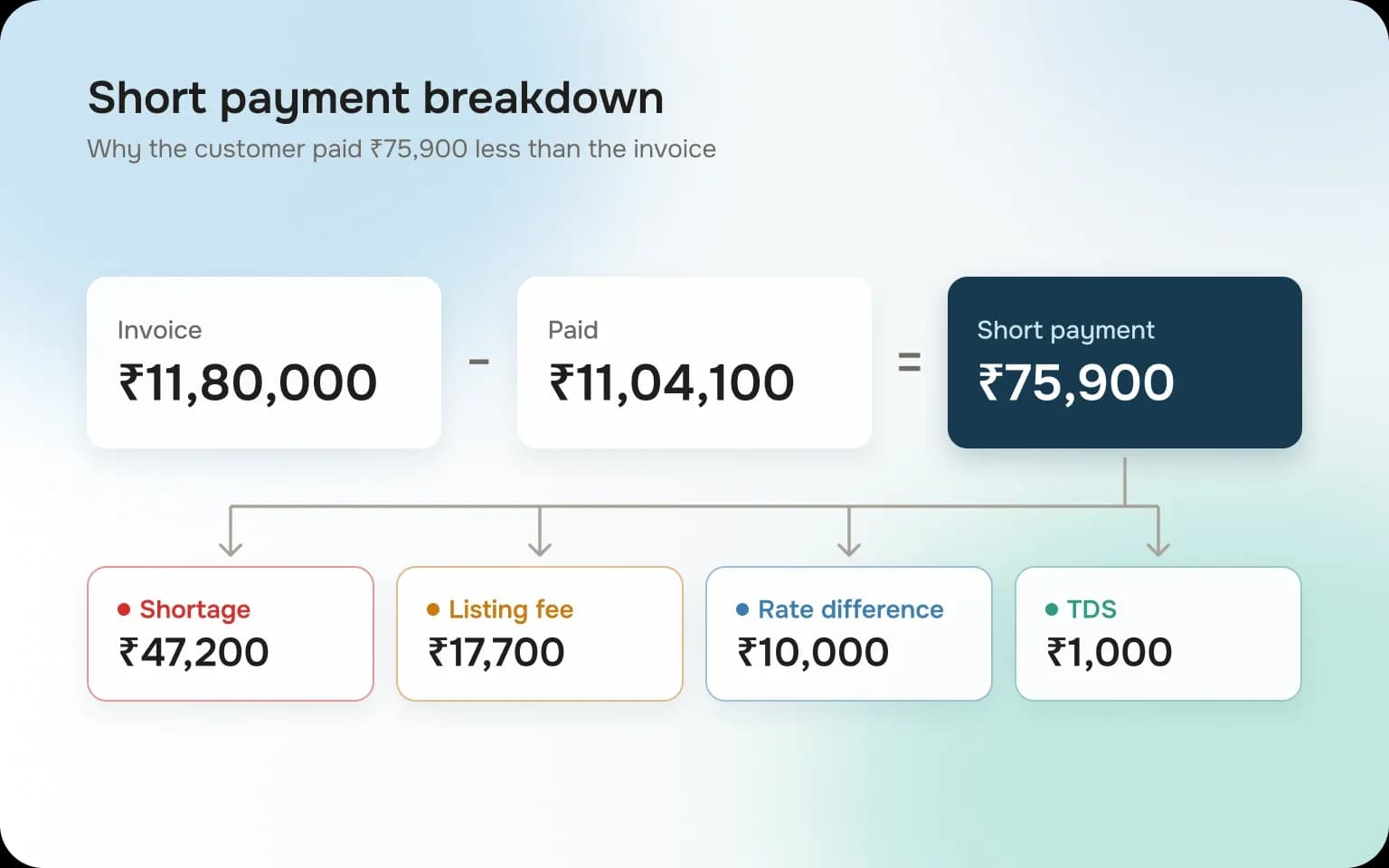
A short paid invoice is an invoice the customer has paid only in part, on purpose, citing a reason. If you bill a retail chain ₹11,80,000 and receive ₹11,04,100, the ₹75,900 short payment received is a deduction. The customer usually explains it in a remittance advice, a portal statement or a debit note from the customer listing each claim.
Valid vs invalid deductions
Type | What it means | Example | What you do |
|---|---|---|---|
Valid | The claim matches the agreement and the evidence | 20 cases short on the GRN, confirmed by the delivery record | Accept and issue a credit note |
Invalid | The claim has no basis or contradicts the evidence | Rate claim at last quarter's price when the new price was agreed in writing | Dispute with documents and recover |
Partly valid | Some of the claim holds, some does not | Damage claim for 50 units when photos show 20 | Accept part, dispute the rest |
Non-dispute | A statutory or agreed deduction, not a claim | TDS deducted by the buyer, or an agreed early-payment discount | Match and close |
Types of Customer Deductions in FMCG
By reason
- Shortages: the customer records fewer units on its GRN than you invoiced. These are the most common retailer deductions in modern trade, and they hit working capital hard, as our framework on how shortage claims impact working capital shows.
- Damages and expiry: goods rejected at the dock or returned later as damaged, near-expiry or expired.
- Pricing and rate differences: the customer pays at a price it believes is correct, often an old price, a different MRP or a margin it expects. See ways to handle pricing mismatch.
- Trade promotion deductions: scheme claims, off-invoice discounts, display or visibility support, and promotional price support that the customer deducts instead of claiming separately.
- Fees and charges: listing fees, new-store opening support, marketing or visibility fees on platforms.
- Penalties: late delivery, missed appointments, low fill rate or non-compliant labelling.
- Returns: goods sent back through a return-to-vendor (RTV) process, where the value is deducted from the next payment.
- Statutory and agreed deductions: TDS, cash discounts and agreed settlement terms.
By channel
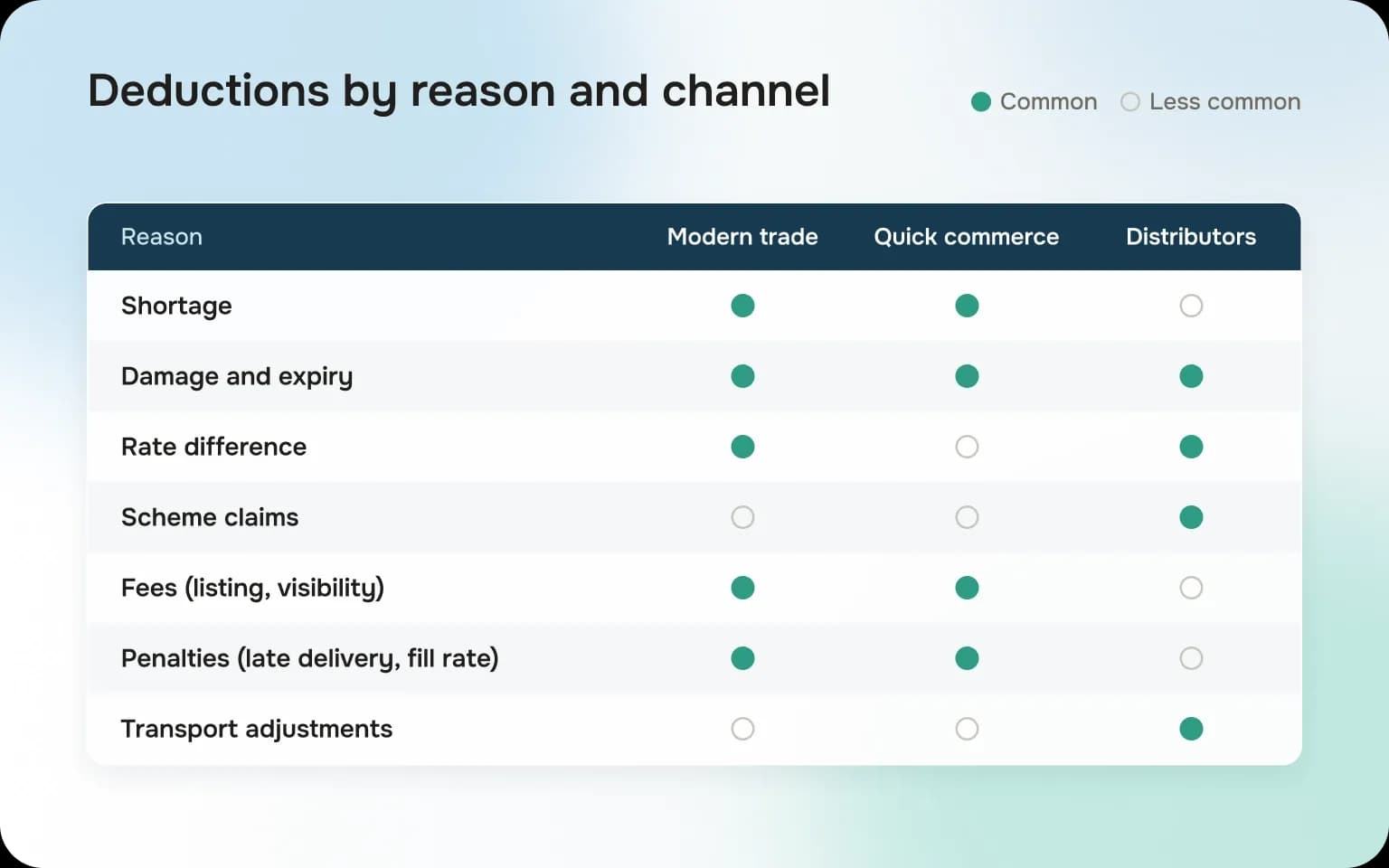
Channel | Common deductions | Main evidence to check |
|---|---|---|
Modern trade chains | Shortages against GRN, damages, rate differences, listing and display fees, late delivery penalties | PO, invoice, GRN, proof of delivery, price agreement, appointment records |
Quick commerce platforms | Dark store shortages, expiry and quality rejections, visibility and marketing fees, fill-rate penalties | Platform GRN and portal statements, inward photos, commercial terms |
Distributors (general trade) | Scheme claims, rate difference claims, damage and expiry claims, transport adjustments | Scheme circulars, secondary sales data, claim forms |
Quick commerce has added a new layer of cost. In December 2025, FMCG executives told Storyboard18 that margins on quick commerce fell by an estimated three to five percentage points over three to six months as promotional costs rose, so every unchecked fee or penalty on top of that matters even more.
Why Deduction Management Matters
Deductions sit where three large numbers meet: trade spend, receivables and margin.
- Trade spend is big. McKinsey finds that, across industries, companies commonly spend 8 to 11 percent of revenue on trade incentives, with some going up to 20 percent. A 2023 Roland Berger analysis puts trade at as much as 30% of gross revenue for consumer goods makers. A large share of that money is settled through deductions, so weak checks here leak margin fast.
- Open deductions inflate DSO. Until a deduction is resolved, it sits in receivables and makes collections look slower than they are. Our guide to days sales outstanding shows how open deductions and unapplied cash push DSO up.
- Unchecked deductions are revenue leakage. When a team accepts small claims to save time, invalid ones pass through with them. Over a year, this becomes one of the hidden ways revenue leaks in CPG enterprises.
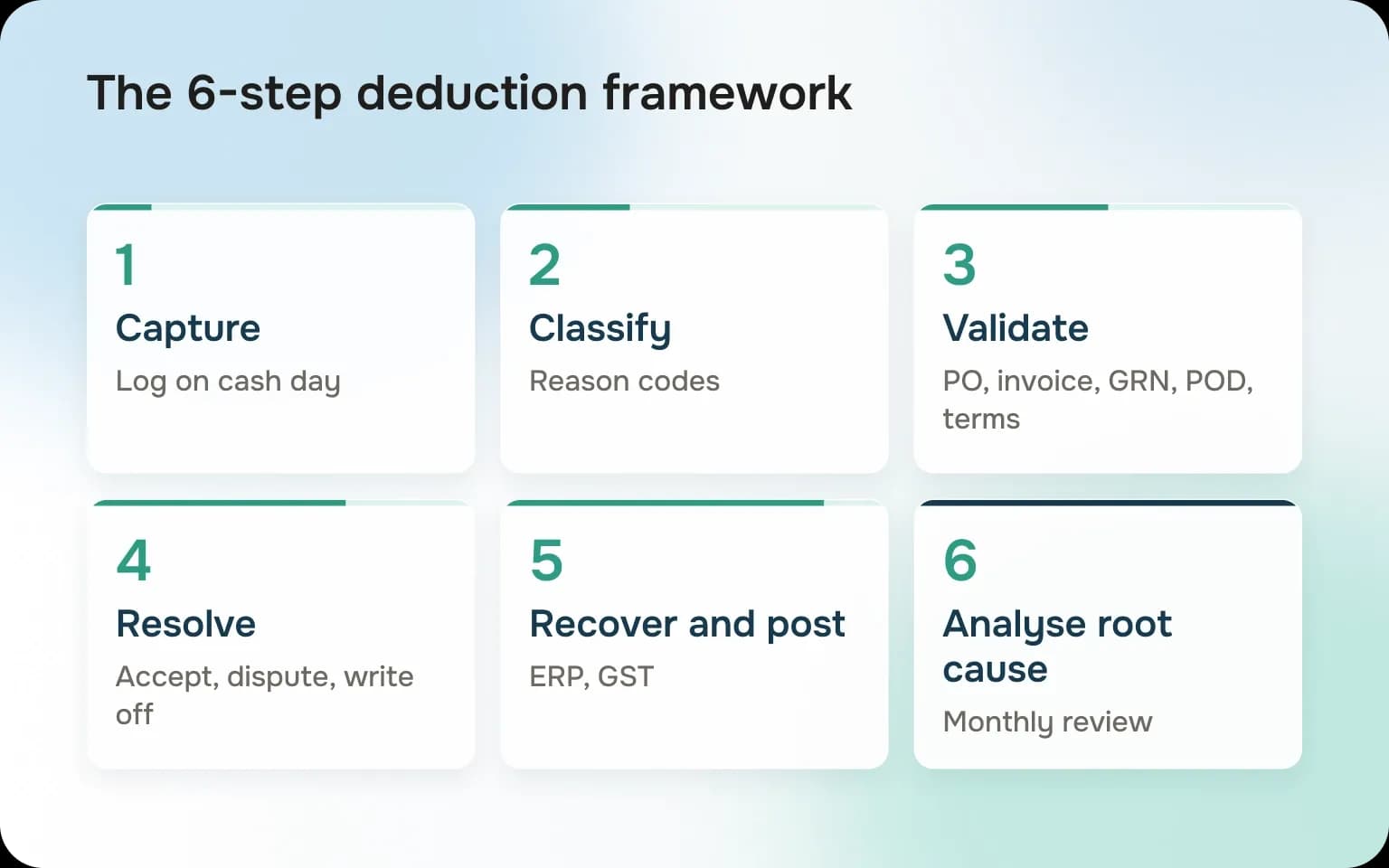
The Deduction Management Process: A 6-Step Framework
This deduction management process works for any channel. The steps stay the same; only the evidence changes.
Step 1: Capture every deduction on the day the cash arrives
Deductions are born at cash application. When a payment is matched to invoices, any shortfall should be logged as a separate deduction line with the customer, invoice, amount, date and the customer's reason, not left as an unexplained balance on the invoice.
- Pull reasons from every source: remittance advices, retailer portal statements, debit notes sent by email, and bank narrations.
- Give each deduction an ID and an owner.
- Start the clock: note the customer's dispute window from the day you receive the payment. Windows differ by customer agreement and portal, so record each customer's window in your customer master rather than assuming one.
Step 2: Classify by reason code
Use one short list of reason codes across all customers so you can report on them. A simple set:
Code | Reason | Usual owner |
|---|---|---|
SHT | Shortage | Logistics |
DMG | Damage, expiry or quality | Logistics and quality |
PRC | Price or rate difference | Sales operations |
PRM | Scheme or trade promotion claim | Sales and trade marketing |
FEE | Listing, visibility or marketing fee | Key account manager |
PEN | Penalty (late delivery, fill rate) | Logistics |
RTV | Return to vendor | Customer service |
TDS | Tax deducted at source | Finance |
Customers use their own codes. Map them to yours once, and reuse the mapping.
Step 3: Gather backup and validate
This is the step that decides how much you recover. For each deduction, collect the customer's backup and compare it with your own records:
- Shortages and damages: check the claim against the goods receipt note, your dispatch record and the signed proof of delivery. If your POD shows full delivery with no remarks, the shortage is likely invalid.
- Rate differences: check the price agreed for that period, the PO price and the invoice price.
- Scheme claims: check the scheme circular, its validity dates, eligible SKUs and the quantity actually sold.
- Fees and penalties: check the signed commercial terms. A fee not in the agreement is a candidate for dispute.
- Returns: match the deduction to an approved RTV and the goods actually received back.
- Duplicates: look for the same invoice line claimed twice, a common source of loss.
Mark each deduction valid, invalid, partly valid or non-dispute, and record why.
If your team spends most of its time downloading portal statements and matching debit notes by hand, see how Finifi's debit note automation validates each note against invoices, GRNs, returns and agreed terms on the day it arrives.
Step 4: Resolve by Accepting, Disputing or Writing Off
- Accept valid deductions by issuing the right document, usually a credit note, and closing the line.
- Dispute invalid deductions with evidence attached: the GRN, POD, price agreement or scheme terms. Send it through the customer's preferred channel and inside its window. Our framework on dispute handling for FMCG enterprises covers how to run disputes well.
- Write off small items only below an approved threshold, with a named approver, and still record the reason code so the pattern is visible.
Step 5: Recover and post correctly
Recovered amounts usually come back as a separate payment or as an offset against a later payment, so link them to the original deduction ID. Post every outcome in your ERP with the right accounts and GST treatment (see the next section), and close the line only when the money or the document is in.
Step 6: Analyse root causes and prevent repeats
Every month, review deductions by customer, reason code, SKU, depot and transporter. Then fix the source:
- Repeated shortages at one DC may point to a transporter, a packing issue or a GRN practice to raise with the customer.
- Rate claims after every price change mean price updates are not reaching customers on time.
- Penalties for missed delivery slots call for better appointment scheduling in modern trade.
Short Payment Accounting: Entries and GST Treatment
The worked example below is illustrative. Your chart of accounts and your auditor's guidance decide the final treatment.
Worked example
A brand invoices a modern trade chain ₹11,80,000 (₹10,00,000 plus 18% GST). The chain pays ₹11,04,100 and sends a debit note from the customer listing four deductions:
Deduction | Amount (₹) | Finding after validation |
|---|---|---|
Shortage of 20 cases (₹40,000 + GST) | 47,200 | Valid: GRN and POD both show the shortage |
Listing fee for a new store (₹15,000 + GST) | 17,700 | Valid: in the signed terms |
TDS deducted by the buyer (illustrative: 0.1% of the ₹10,00,000 taxable value) | 1,000 | Non-dispute |
Rate difference at the old price | 10,000 | Invalid: new price agreed in writing |
Total short payment | 75,900 |
Journal entries
Event | Debit | Credit |
|---|---|---|
1. Payment received | Bank ₹11,04,100; Deductions clearing ₹75,900 | Customer ₹11,80,000 |
2. Shortage accepted, GST credit note issued | Sales returns or shortage ₹40,000; Output GST ₹7,200 | Deductions clearing ₹47,200 |
3. Listing fee booked against the retailer's tax invoice | Trade promotion expense ₹15,000; Input GST ₹2,700 | Deductions clearing ₹17,700 |
4. TDS recognised | TDS receivable ₹1,000 | Deductions clearing ₹1,000 |
5a. Invalid rate claim recovered | Bank ₹10,000 | Deductions clearing ₹10,000 |
5b. Or, if written off with approval | Deductions written off ₹10,000 | Deductions clearing ₹10,000 |
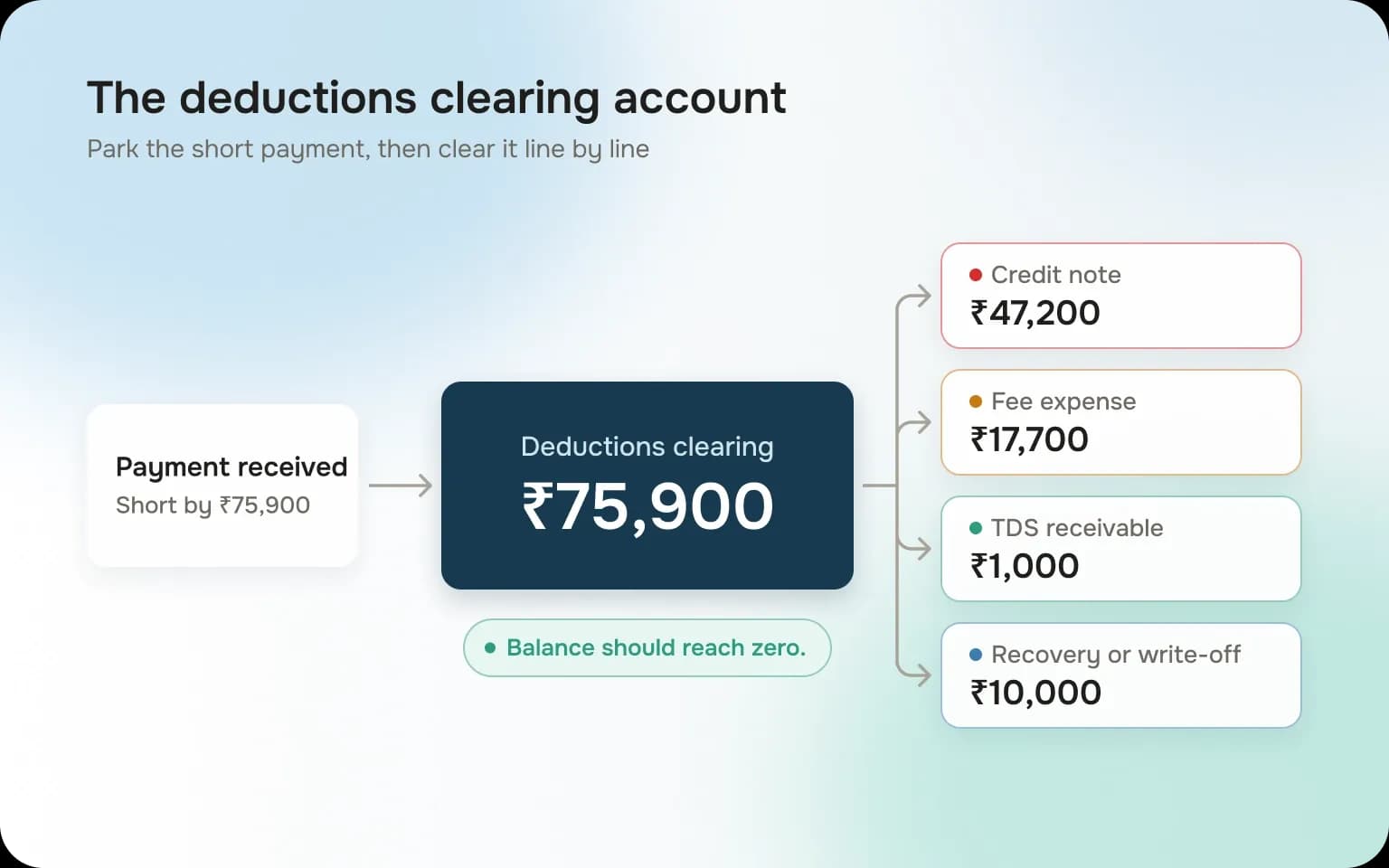
A deductions clearing account (or a deduction sub-ledger by customer) keeps the invoice closed while each claim is worked. The account should go to zero as every line is resolved. A balance that keeps growing is a warning sign.
GST points to get right
- A debit note from the customer is not a GST document for your output tax. Under Section 34 of the CGST Act, it is the supplier who issues a credit note to reduce the taxable value or tax on its invoice. The customer's debit note is the trigger; your credit note is the document.
- Watch the deadline. Section 34 requires the credit note to be declared in a return no later than 30 November after the end of the financial year of the supply, or the date of filing the annual return, whichever is earlier. After that, you can still settle commercially, but GST already paid stays paid.
- Fees need the retailer's tax invoice. When a retailer provides a real service, such as display or advertising under a separate agreement, it is a separate supply and the retailer should charge GST on its own invoice. CBIC's Circular 251/08/2025-GST explains when a post-sale discount is linked to such a service. A deduction without an invoice gives you no input tax credit.
- Write-offs do not reduce GST. Writing off an invalid deduction is a commercial loss; it does not reduce the GST on the original invoice.
For the difference between tax and financial credit notes, and the rule changes from 1 November 2026, see our guide to the financial credit note under GST.
Deduction Management KPIs to Track
KPI | Formula | What it tells you |
|---|---|---|
Deduction rate | Deductions taken ÷ gross sales | How much of your billing turns into claims, by customer and channel |
Days deductions outstanding (DDO) | Open deductions ÷ deductions taken in the period × days in the period | How long deductions stay unresolved |
Validity rate | Value of valid deductions ÷ value resolved | How much of what customers claim is fair |
Recovery rate | Value recovered ÷ value of invalid deductions | How well you win disputes |
Ageing | Open deductions by 0 to 30, 31 to 60, 61 to 90 and 90+ days | Which items are close to the customer's dispute window |
Write-off share | Value written off ÷ value resolved | Whether small-value write-offs are hiding a pattern |
Worked example: deduction rate and DDO
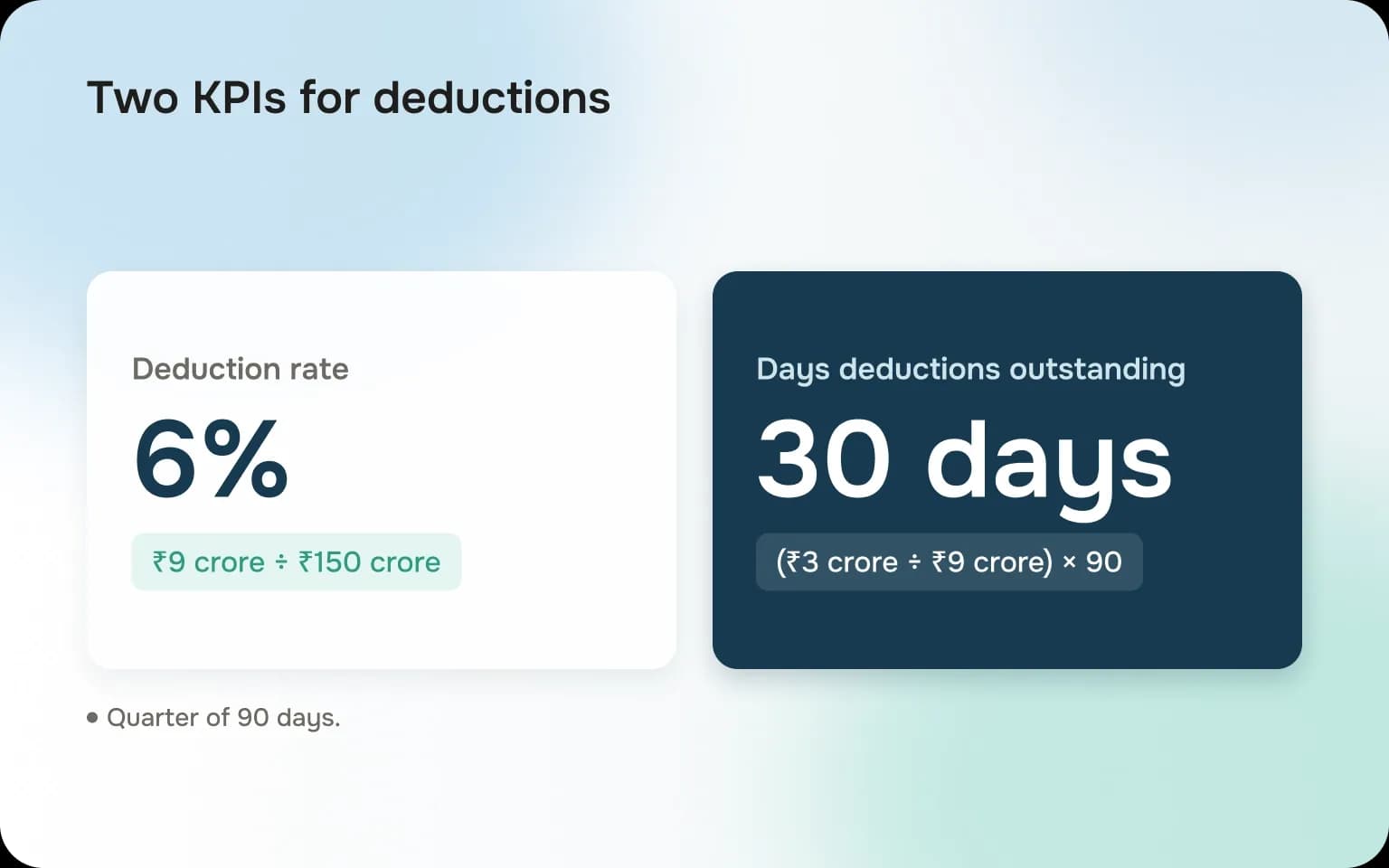
In a quarter (90 days), a brand bills ₹150 crore to modern trade and quick commerce. Customers take ₹9 crore in deductions, and ₹3 crore is still open at quarter end.
- Deduction rate = 9 ÷ 150 = 6%
- DDO = (3 ÷ 9) × 90 = 30 days
Common Deduction Management Mistakes
Mistake | Why it costs you | Better practice |
|---|---|---|
Leaving deductions on the invoice as an unpaid balance | Nobody owns them, and they age quietly in receivables | Log each deduction as its own line with an owner on the day cash arrives |
Accepting all small claims | Invalid claims pass in bulk, and patterns stay hidden | Use a write-off threshold with approval and still code the reason |
Chasing backup over email | Slow, and evidence gets lost | Keep GRNs, PODs, price agreements and scheme terms in one place, linked to the invoice |
Missing the customer's dispute window | Valid disputes become unrecoverable | Track the window from day one and work the oldest items first |
Measuring only total deductions | One bad customer or depot hides inside the average | Report by customer, reason code, SKU and depot |
Treating deductions as a finance-only job | Root causes in sales, logistics and pricing never get fixed | Share the monthly reason-code report with each owner |
Automating Deduction Management
The business challenge
A consumer brand selling to large retail chains and quick commerce platforms can receive hundreds of debit notes a month, in different formats, across email and buyer portals. Each one has to be matched to an invoice and checked against a GRN, a return, a price or a scheme before the dispute window closes. When volume beats capacity, valid and invalid claims get accepted together, DSO rises and margin leaks.
How companies usually solve it
Most teams download portal statements, copy debit notes into spreadsheets and email depots for backup. Large claims get reviewed; small ones are often accepted to save time, and root-cause reports are built by hand, if at all.
The automated approach
Finifi is operations AI for Order-to-Cash and Procure-to-Pay, built for consumer brands in India. As deduction management software made for Indian FMCG channels, its debit note automation covers the capture, validation, approval and dispute steps of this framework every day:
- Captures debit notes automatically from email and buyer portals and reads them into structured data.
- Validates each note against invoices, GRNs, dispatch records, returns, agreed rates and schemes. Claims that match are cleared; scheme claims and possible duplicates go for review.
- Routes approvals by amount, customer, reason or risk.
- Raises disputes with the GRN and terms attached while there is still time to recover.
- Syncs approved notes to your ERP, including SAP, Oracle, Dynamics 365 and Tally, and links them to cash application so every short payment is explained.
Go-live typically takes under two weeks. Consumer brands including Jyothy Labs, Bikaji, Happilo and Balaji Wafers use Finifi.
If deductions are eating into your margin or holding up your DSO, talk to the Finifi team to see how it would work with your customers, portals and ERP.
Frequently Asked Questions
What is deduction management?
Deduction management is the process of capturing, validating and resolving the amounts customers hold back when they pay an invoice. It covers checking each claim against the PO, invoice, GRN, proof of delivery and agreed terms, then accepting, disputing or writing it off and posting the result.
What is the deduction management process?
A six-step process works well: capture every deduction when cash arrives, classify it by reason code, gather backup and validate it, resolve it by accepting, disputing or writing off, recover and post it correctly, and analyse root causes to prevent repeats.
What does a short paid invoice mean?
A short paid invoice is one the customer has paid only in part, on purpose, citing a reason such as a shortage, damage, rate difference, scheme claim or fee. The unpaid difference is a deduction that must be validated before it is accepted or disputed.
What are deductions in accounts receivable?
Deductions in accounts receivable are open balances created when customers pay less than the invoice amount and give a reason. Until they are resolved, they stay in receivables and raise days sales outstanding.
Is a debit note from a customer valid under GST?
A debit note from a customer is a commercial document that explains its claim. It does not reduce your output GST. If the claim is valid and you want to reduce the tax, you as the supplier must issue a credit note under Section 34 of the CGST Act within the time limit.
How do you account for a short payment received?
Record the amount received in the bank, move the shortfall to a deductions clearing account against the customer, then clear each line as it is resolved: a credit note for valid claims, an expense for agreed fees backed by the retailer's invoice, TDS receivable for tax deducted, and recovery or approved write-off for invalid claims.
What KPIs should you track for deductions?
Track deduction rate, days deductions outstanding, validity rate, recovery rate, ageing and write-off share, broken down by customer, reason code, SKU and depot.