Days Sales Outstanding (DSO): Formula, Examples and How FMCG Brands Reduce It
How to calculate DSO, what a good number looks like for FMCG brands, and the 7 fixes that bring collection days down, with worked examples.
Punithkumar
18 NOV 2026 · 14 min read

Last updated: 12 November 2026
Days sales outstanding (DSO) tells you how many days, on average, it takes your business to turn a credit sale into cash. For an FMCG or consumer brand in India, it is one of the clearest signals of how well sales, distribution and finance work together. Two brands with the same revenue can have very different cash positions simply because one collects in 20 days and the other in 50.
TL;DR: Days sales outstanding = (accounts receivable ÷ credit sales) × number of days in the period. A DSO of 30 means you collect, on average, 30 days after the sale. Lower is usually better, but compare it with your payment terms and your channel mix. In FMCG, DSO often rises not because customers refuse to pay, but because of unresolved deductions, unapplied payments and slow dispute handling.
What is Days Sales Outstanding (Meaning)
The days sales outstanding meaning, or DSO definition, is simple: it is the average number of days between making a credit sale and receiving the money. It is also called the average collection period, debtor days, receivable days or days in accounts receivable. If your DSO is 40, then on average your customers pay 40 days after you invoice them.
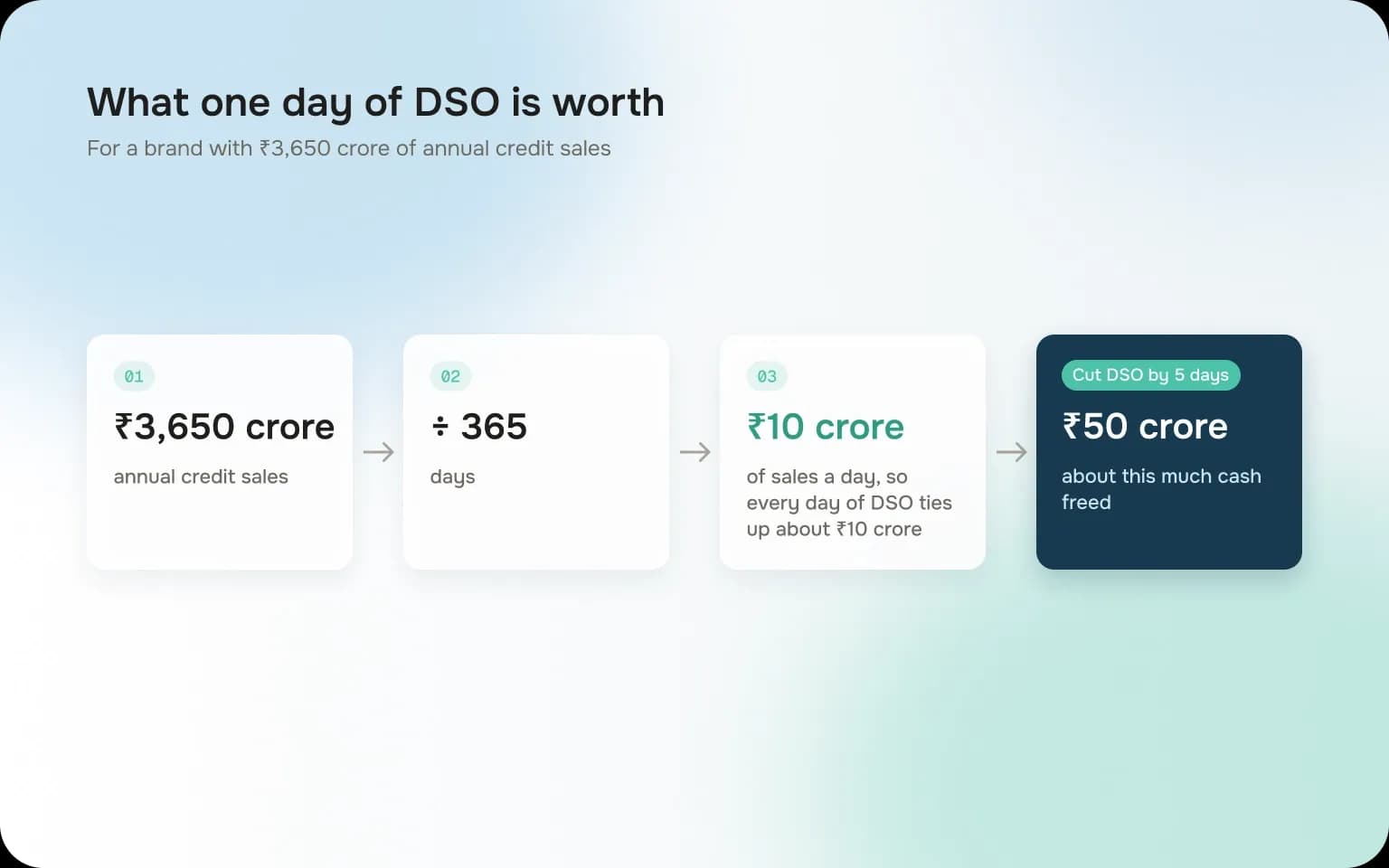
DSO matters because cash tied up in receivables is cash you cannot use for stock, salaries or growth. A brand with ₹3,650 crore of annual credit sales carries about ₹10 crore of receivables for every day of DSO. Cutting DSO by 5 days frees about ₹50 crore.
Days sales outstanding vs receivable days
In practice, days sales outstanding and receivable days (or debtor days) mean the same thing: how long receivables take to turn into cash. The difference is usually only in how each is calculated.
Term | Usually calculated as | Where you see it |
|---|---|---|
Days sales outstanding (DSO) | Receivables ÷ credit sales × days in the period | Finance teams, monthly reporting |
Receivable days / debtor days | Average receivables ÷ annual revenue × 365 | Annual reports, equity research |
Receivable turnover days | 365 ÷ receivables turnover ratio | Ratio analysis, CFA and other exams |
All three answer the same question. What matters is that you use one method consistently, so the trend is meaningful.
Days Sales Outstanding Formula
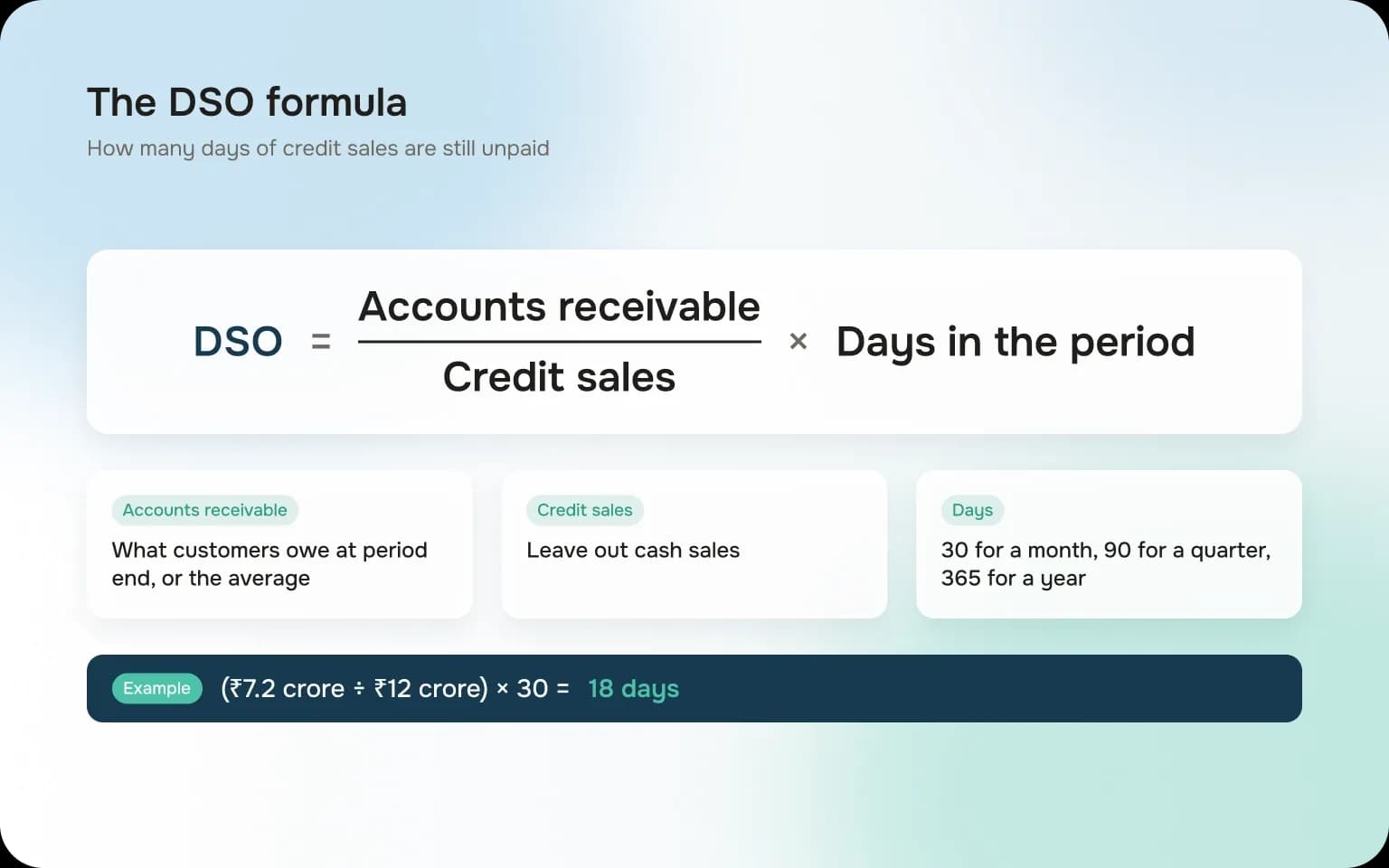
The standard days sales outstanding formula is:
DSO = (Accounts receivable ÷ Credit sales) × Number of days in the period
- Accounts receivable: what customers owe you at the end of the period (or the average across it).
- Credit sales: sales made on credit in the same period. Leave out cash sales, because they are collected on day zero.
- Number of days: 30 for a month, 90 for a quarter, 365 for a year. Some companies use 360; pick one and stay with it.
The days in accounts receivable formula is the same: accounts receivable ÷ credit sales × number of days in the period. Only the name changes.
Using average receivables
If receivables swing a lot within the year, use the average:
Average receivables = (Opening receivables + Closing receivables) ÷ 2
This smooths out a large sale on the last day of the month, which would otherwise inflate DSO.
The GST adjustment most Indian teams miss
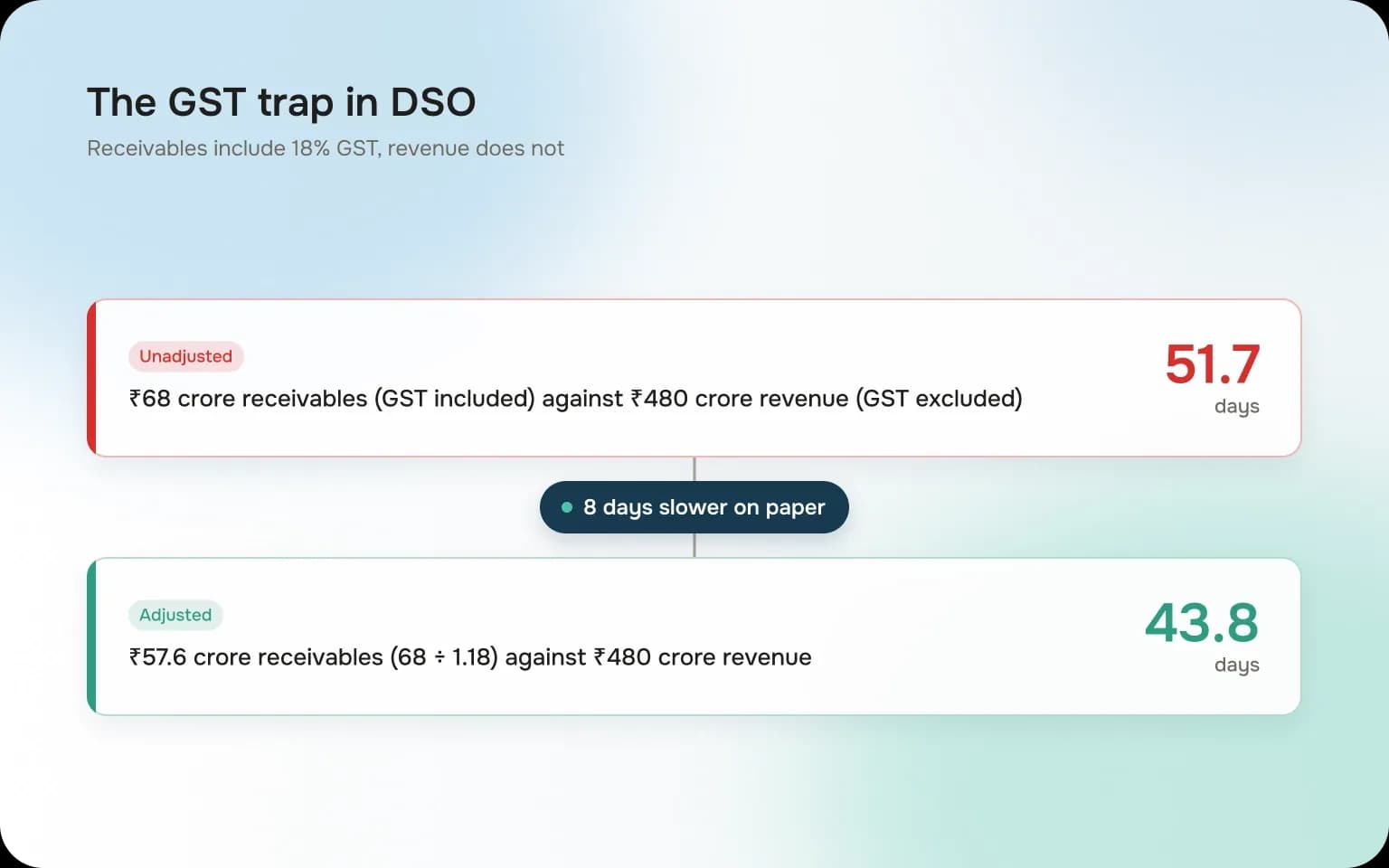
Trade receivables in India include GST, because customers owe you the tax-inclusive invoice value. Revenue in your books excludes GST. Divide one by the other and DSO looks higher than it really is. For goods taxed at 18%, the overstatement is close to 18%. Either take credit sales including GST, or strip GST out of receivables, so both sides of the formula match.
Days sales outstanding ratio and the CFA formula
DSO is the flip side of the receivables turnover ratio:
Receivables turnover = Credit sales ÷ Average receivables
DSO (receivable turnover days) = 365 ÷ Receivables turnover
This is the days sales outstanding formula CFA candidates learn. It gives the same answer as the standard formula when you use the same inputs.
Two more measures worth tracking
- Countback DSO: start with this month's closing receivables and subtract each month's credit sales, going backwards, until receivables are used up. Add the days you counted back. It handles growth and seasonal spikes better than the simple formula.
- Best possible DSO (BPDSO): use only receivables that are not yet due. It shows what your DSO would be if every customer paid on time. The gap between DSO and BPDSO is your average days delinquent, the part of DSO caused by late payment rather than your terms.
Days Sales Outstanding Examples
These days sales outstanding formula examples use one illustrative consumer brand. All figures exclude GST unless stated.
Example 1: Monthly DSO
In September (30 days), the brand makes ₹12 crore of credit sales. Closing receivables are ₹7.2 crore.
DSO = (7.2 ÷ 12) × 30 = 18 days
Example 2: Annual DSO with average receivables
For the year, credit sales are ₹480 crore. Receivables were ₹52 crore at the start and ₹68 crore at the end.
- Average receivables = (52 + 68) ÷ 2 = ₹60 crore
- DSO = (60 ÷ 480) × 365 = 45.6 days
- Check with the ratio method: receivables turnover = 480 ÷ 60 = 8, and 365 ÷ 8 = 45.6 days
Example 3: The GST trap
Example 3 uses closing receivables on purpose, because many teams simply divide the year-end ledger balance by annual revenue. That is why it gives a different answer from the 45.6 days in Example 2, which uses the average. Suppose the ₹68 crore closing receivables include 18% GST, and the team divides it by revenue without adjusting.
Method | Receivables used | DSO |
|---|---|---|
Unadjusted (GST in receivables, not in sales) | ₹68 crore | 51.7 days |
Adjusted (GST removed: 68 ÷ 1.18) | ₹57.6 crore | 43.8 days |
The same business looks 8 days slower just because of a mismatch in the inputs.
Example 4: Countback DSO
Closing receivables are ₹30 crore. Credit sales were ₹20 crore in September (30 days) and ₹15 crore in August (31 days).
- Take away September's sales: 30 − 20 = ₹10 crore left, and count all 30 days.
- The remaining ₹10 crore is two-thirds of August's ₹15 crore, so count 10 ÷ 15 × 31 = 20.7 days.
- Countback DSO = 30 + 20.7 = 50.7 days
A simple days sales outstanding calculator in Excel
You can build a DSO calculator in a sheet with four cells:
Cell | Label | Example value |
|---|---|---|
B1 | Credit sales for the period (₹) | 12,00,00,000 |
B2 | Closing receivables, same GST basis (₹) | 7,20,00,000 |
B3 | Days in the period | 30 |
B4 | DSO | =B2/B1*B3 |
Add a row per month and chart B4 over time. The trend tells you far more than any single number.
What Is a Good Days Sales Outstanding for FMCG Brands?
There is no single good number. A good DSO is one that is close to your average payment terms and stable or falling over time. Still, a few reference points help.
Large listed FMCG companies
India's biggest FMCG companies collect fast. In FY 2025-26, debtor days were 19 for Hindustan Unilever and 20 for Dabur on a consolidated basis. These figures use total revenue, including sales collected in advance, so they flatter the true credit DSO. Smaller and mid-sized brands often have less bargaining power with large retailers, so treat these figures as a reference point, not a target.
Payment cycles by channel
DSO in FMCG depends heavily on where you sell. Modern trade chains often settle on fixed cycles. One industry analysis lists DMart at 7 days, Reliance Smart at 10, More Retail at 14, and Spencer's and Star Bazaar at 21, for suppliers in good standing. Terms vary by contract, and the cash you actually receive arrives after deductions, so the settled amount can be less than the invoice.
Channel | What drives DSO |
|---|---|
Distributors (general trade) | Credit terms you set, often short; disputes over schemes and claims |
Modern trade | Fixed settlement cycles, plus deductions for short receipts, damages and listing fees |
Quick commerce | Platform settlement cycles and deductions at the dark store |
Institutional and exports | Longer contractual terms |
The wider Indian picture
Late payment is common across Indian B2B trade. Atradius's 2025 survey for India found that overdue invoices affect an average 63% of credit-based B2B sales, and bad debts have risen to an average 7% of B2B invoices. That makes DSO a number worth watching every month, not just at year end.
Why Days Sales Outstanding Rises in FMCG
Generic guides blame slow-paying customers. In FMCG, much of the problem sits inside your own process. These are the usual causes.
Unapplied cash
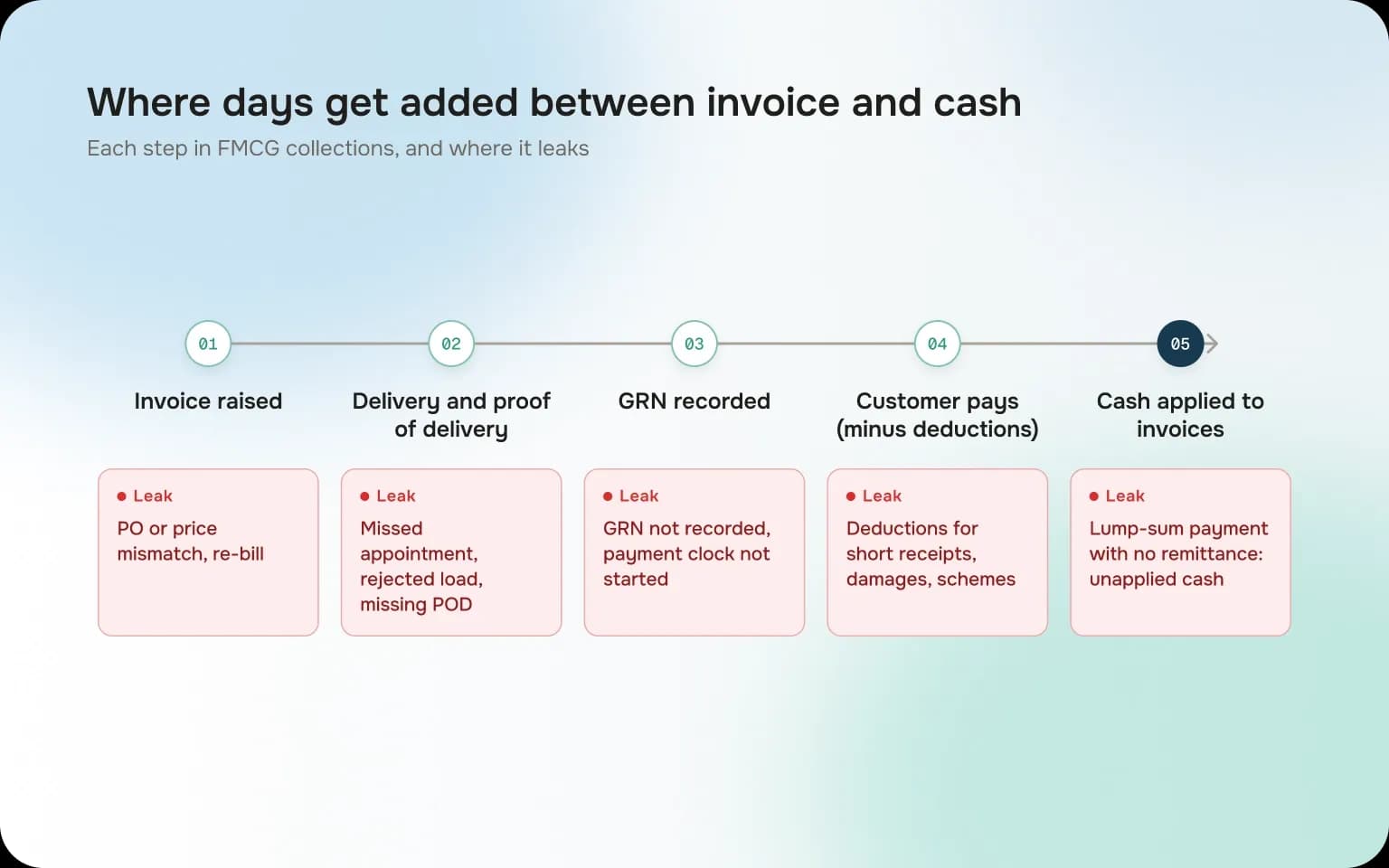
A customer pays, but the payment cannot be matched to invoices because the remittance is missing, arrives in a portal statement, or covers dozens of invoices in one lump sum. Until someone matches it, the invoices stay open and DSO looks higher than it really is. The cash is in your bank, but your receivables ledger does not know it.
Open deductions
Modern trade and quick commerce customers often pay the invoice minus deductions for short receipts, damages, schemes or listing fees. The unpaid balance stays in receivables until someone checks the claim and either accepts it with a credit note or disputes it. Unchecked deductions also leak revenue: they are a classic source of revenue leakage in CPG.
Delivery and GRN delays
Many large retailers settle only after they record the goods receipt note (GRN). Missed delivery appointments, rejected loads or missing proof of delivery push collections out by days or weeks.
Invoice and PO mismatches
A wrong price, an expired PO, a different pack size or an MRP mismatch gives the customer a reason to hold payment. Each one has to be fixed and re-billed before cash arrives.
Credit terms creep
Sales teams extend terms to win a listing or hit a quarter-end target. Each exception looks small, but together they lift DSO for the whole book.
Weak follow-up
If nobody reminds customers before due dates, or disputes sit in email for weeks, payment slips. This is the cause most guides focus on, and in FMCG it is rarely the only one.
How to Reduce Days Sales Outstanding
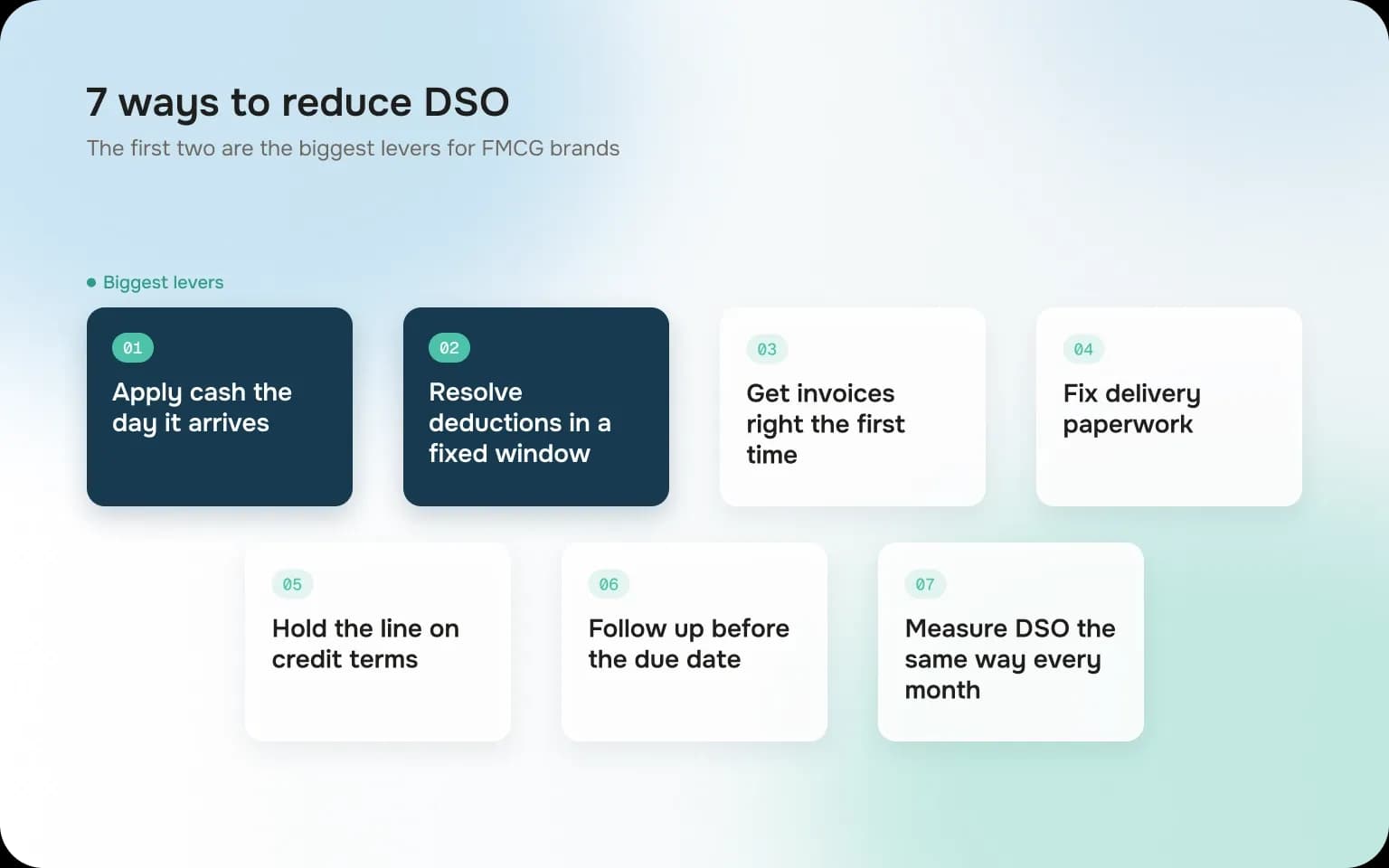
Start by splitting your DSO into its parts. Compare it with best possible DSO to see how much comes from late payment, and check how much of your open receivables is really unapplied cash or open deductions. Then work on the biggest piece first.
- Apply cash the day it arrives. Match every receipt to invoices on the same day, using bank statements, remittance advices and customer portal statements. This alone can take days off reported DSO without a single customer paying faster.
- Resolve deductions within a fixed window. Check each short payment against the GRN, proof of delivery, agreed prices and scheme terms. Accept valid claims with a credit note, dispute the rest with evidence, and set a target such as 15 days to close each one.
- Get invoices right the first time. Validate POs before dispatch, and check price, pack size and MRP before the invoice goes out. Every invoice error becomes a payment delay.
- Fix delivery paperwork. Book delivery appointments, capture proof of delivery, and chase GRNs from large customers so the payment clock starts on time.
- Hold the line on credit terms. Set terms by channel and customer, track exceptions, and review them every quarter with sales.
- Follow up before the due date. Send reminders before payment is due, not after, and give each overdue account a named owner.
- Measure DSO the same way every month. Use the same formula, the same GST basis and the same period length, and report it by channel and by top customers.
If unapplied cash and open deductions are a big part of your receivables, see how Finifi's cash application matches payments to invoices and explains short payments on the day the money arrives.
Common Mistakes When Calculating DSO
Mistake | Why it distorts DSO | Fix |
|---|---|---|
Mixing GST and non-GST figures | Receivables include GST, revenue does not, so DSO looks inflated | Put both on the same GST basis |
Using total sales instead of credit sales | Cash sales are collected on day zero and pull DSO down | Use credit sales only, if you can separate them |
Using only closing receivables in a seasonal business | A big festive-season month-end makes DSO jump | Use average receivables or the countback method |
Ignoring unapplied cash | Paid invoices stay open in the ledger | Apply cash before you measure DSO |
Leaving disputed deductions in receivables for months | Old, uncollectable amounts inflate DSO and hide revenue leakage | Close or write off deductions on a fixed timeline |
Comparing DSO across channels as one number | A mix shift towards modern trade can raise DSO even when collections improve | Report DSO by channel |
Changing the formula between periods | The trend becomes meaningless | Fix one method and document it |
Automating Collections to Bring DSO Down
The business challenge
For a consumer brand, DSO is shaped by thousands of small events: a lump-sum payment with no remittance, a short payment from a retail chain, a missing proof of delivery, a scheme claim nobody has checked. Each one keeps an invoice open a little longer, and together they add days to DSO and quietly leak revenue.
How companies usually solve it
Most AR teams download bank statements and portal statements, match payments to invoices in spreadsheets, and chase deduction backup over email. Large claims get checked; small ones are often accepted to save time. Cash application runs days behind the bank, so reported DSO is always worse than reality.
The automated approach
Finifi is operations AI for Order-to-Cash and Procure-to-Pay, built for consumer brands in India. Its cash application and debit note automation work on the causes of high DSO, not just the reminders:
- Reads every payment source, including payment advices, bank statements and customer portal statements, in any format.
- Matches payments to open invoices, including partial and lump-sum payments, on the day the money arrives.
- Explains short payments by linking them to debit notes, returns and agreed schemes, and checks each claim against the GRN, dispatch records and agreed prices.
- Sends only disputes to your team, with the evidence attached, and disputes invalid deductions.
- Posts receipts, credit notes and adjustments to your ERP, including SAP, Oracle, Dynamics 365, Zoho and Tally, with a full trail. Cash application typically goes live in about two weeks.
Consumer brands including Happilo, Bikaji, Jyothy Labs and Chheda's use Finifi.
If unapplied cash and open deductions are holding up your DSO, talk to the Finifi team to see how it would work with your customers, banks and ERP.
Frequently Asked Questions
What is days sales outstanding?
Days sales outstanding (DSO) is the average number of days a business takes to collect cash after a credit sale. It is also called the average collection period, debtor days or receivable days.
What is the days sales outstanding formula?
DSO = (Accounts receivable ÷ Credit sales) × Number of days in the period. Use 30 days for a month, 90 for a quarter and 365 for a year, and keep both receivables and sales on the same GST basis.
What is a good DSO?
A good DSO is close to your average payment terms and stable or falling over time. Large Indian FMCG companies report debtor days of around 20, but the right level depends on your channel mix and customer terms.
Is days sales outstanding the same as receivable days?
Yes, they measure the same thing: how long receivables take to turn into cash. The only difference is usually the calculation method, such as using average receivables and annual revenue for receivable days.
How do you calculate DSO from the receivables turnover ratio?
Divide 365 by the receivables turnover ratio. If credit sales are ₹480 crore and average receivables are ₹60 crore, turnover is 8, and DSO is 365 ÷ 8, or about 45.6 days.
Why is my DSO high even though customers are paying?
Often because payments are not being applied to invoices quickly, or because short payments and deductions sit open in receivables. Both keep invoices open after the cash has arrived.
How can FMCG brands reduce DSO?
Apply cash the day it arrives, resolve deductions within a fixed window, get invoices and delivery paperwork right, hold the line on credit terms, follow up before due dates, and track DSO by channel every month.