Every transactionmatched to books
Unified matching across vendors, customers and tax, with bank, ledger and return reconciliations executed end-to-end.
Why enterprise reconciliation breaks.Receivables, payables and tax operate in silos.
Records arrive as
- Bank statements
- Payment advices
- Vendor statements
- Customer ledgers
- GST & TDS returns
Receivables
Unmatched receipts
Payables
Unmatched invoices
Tax
Lost input credit
Accounts
Delayed close
Records arrive from banks, customers, vendors and the GST and TDS portals, each in a different format. With receivables, payables, tax and accounts on separate systems, receipts sit unmatched, vendor balances drift, input credit slips through filing gaps and the books close late. No single function sees the full reconciliation cycle.
Recon visibility.Unreconciled value across the close cycle.
This quarter
“Which of these balances can we actually sign off?”
10% of transactions unreconciled
*Illustrative figures as % of transaction value
| Revenue booked | 100% |
|---|---|
| Revenue matched | 90% |
| Spend matched | 90% |
| Spend booked | 100% |
Receivables
Wants
Clean customer balances
Worries about
Short payments without remittance
Payables
Wants
Accurate vendor balances
Worries about
Credits and advances left unadjusted
Tax
Wants
Full input tax credit
Worries about
Vendors missing GST filings
Coordinates all three
Controller’s office
Owns the books, the close and the audit.
Finifi gives the controller’s office one view across receivables, payables and tax, with breaks flagged before they reach the books.
Fewer breaks, faster close.What teams see after go-live.
90%
less manual effort
3x
faster month-end close
95%
transactions auto-matched
01
Close visibility
Every balance is visible from bank receipt to ledger entry, across revenue and spend.
02
Fewer manual handoffs
Receivables, payables and tax work from one record instead of passing spreadsheets around.
03
Leakage recovery
Short payments, invalid deductions and missed credits are caught before the books close.
The new reality.Every gap closed, one step at a time.
01 / 05
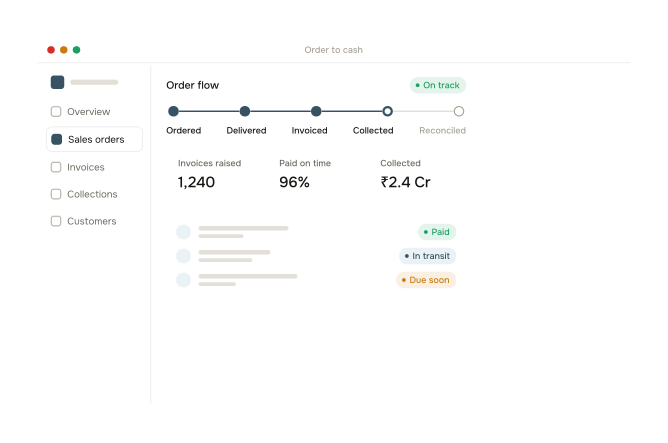
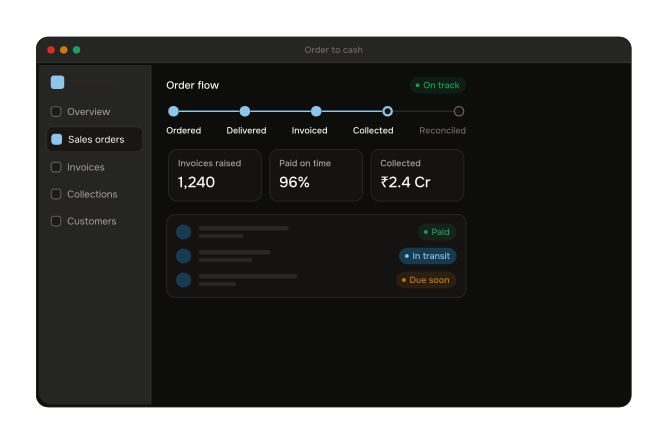
Every receipt matched to its invoice
Bank, UPI and marketplace receipts matched to open invoices and remittances, with exceptions routed for review.
- Matching
- Posting





Reconciliation Core Modules.Nine reconciliations. One system of record.
- Vendor side03
- 01Vendor statement reconVendor statements matched to your payables ledger, with missing invoices, payments and credits flagged.MatchesStatement vs books
- 02GST 2A/2B reconPurchase register reconciled with GSTR-2A/2B, with vendor filing status tracked.MatchesRegister vs 2A/2B
- 03Vendor payment reconEvery payout to a vendor matched to the invoices it settles, the bank debit and the TDS withheld.MatchesPayout vs invoices
- Customer side03
- 04Payment advice reconCustomer payment advices read and matched to invoices, deductions and TDS, line by line.MatchesAdvice vs invoices
- 05Bank reconBank, UPI and marketplace credits matched to receipts, with unidentified credits routed for review.MatchesBank vs receipts
- 06Customer ledger reconCustomer ledgers confirmed against their books, with open items and disputes resolved before close.MatchesLedger vs customer
- Taxation03
- 07GSTR-1 vs 3B reconOutward supplies in GSTR-1 reconciled with GSTR-3B and the sales register before filing.MatchesGSTR-1 vs 3B
- 08ITC eligibilityInput tax credit on 2A/2B checked for eligibility, blocked credits and vendor compliance before it is claimed.Matches2A/2B vs eligible ITC
- 09TDS reconTDS deducted by customers and on vendor payments matched to Form 26AS and your books.Matches26AS vs books


Built for closing gaps.Eight workflows to close the books.
- 01Payment reconciliationRemittance matching against invoices and deductions, with ERP posting.See how
- 02Debit note automationDebit note validation against order terms, with evidence-backed disputes.See how
- 03GRN & RTV managementRetailer GRN and return-note validation against shipped quantities.See how
- 04Dispatch & POD managementDispatch tracking and POD reconciliation at order level.See how
- 05PO invoice processingThree-way match against PO and GRN, with in-flow exception handling.See how
- 06Credit note adjustmentsCredit note capture and reconciliation against open payables.See how
- 07GST 2A/2B reconciliationPurchase register reconciliation with GSTR-2A/2B to protect input tax credit.See how
- 08Audit-ready bookkeepingComplete, traceable action logs with on-demand audit packs.See how


Always on. Always accountable.Customer data remains customer owned.
- SOC 2 Type IIAudited yearly
- Data in IndiaHosted in-region
- Audit-readyQuarterly audits
- AI GovernancePrecise control
Live status · Last 90 days
- Uptime, 90 days
- 99.98%
- Median API response
- < 200 ms
- Infrastructure monitoring
- 24x7
Uptime is published live, so you never take our word for it.
How your data is handled
- Encrypted in transit and at rest
- No training of AI models using customer data
- SSO, MFA and role-based access
- Human sign-off before disbursement
- Immutable audit trail
- India data residency
Questions,answered.
Can’t find yours? Our team will walk you through it on your own data.
What is reconciliation?
Reconciliation is checking every transaction against its record, on three sides: vendors (statements, payments and GST 2A/2B), customers (payment advices, bank receipts and ledgers) and tax (GSTR-1 vs 3B, ITC eligibility and TDS).
Why automate it?
Matching statements, receipts and returns by hand takes days every month and still lets breaks through. Automating it means most transactions match on their own, exceptions reach the right owner early and the books close on time.
Where do the books break?
In receipts without remittance, short payments and unexplained deductions, vendor credits left unadjusted, and input credit lost to vendors missing their GST filings. Finifi flags each break before it reaches the books.
Does it fit our ERP?
Yes. Finifi connects to leading ERPs, including SAP, Microsoft Dynamics, Oracle, Tally and ERPNext, through APIs and standard connectors, and posts clean records back so your ERP stays the system of record.
How fast can we go live?
Most teams go live in less than two weeks, starting with the reconciliation where they lose the most time today.