Goods Receipt Note (GRN): Meaning, Format, Process and Examples
A goods receipt note (GRN) is the buyer's record of goods received, accepted and rejected against a purchase order. It decides what gets paid, how much input tax credit can be claimed, and how much is deducted from each invoice.
Punithkumar
16 NOV 2026 · 16 min read

A goods receipt note (GRN) is the record a buyer creates when goods arrive. It shows what was received against the purchase order and in what condition. It looks like simple warehouse paperwork, but the GRN decides three things: what the buyer pays, how much input tax credit the buyer can claim, and, for brands selling to modern trade and quick commerce, how much of each invoice gets deducted.
TL;DR: A goods receipt note (GRN) is the buyer's record of goods received, accepted and rejected against a purchase order. Finance matches it with the PO and the supplier invoice (three-way matching) before paying. For sellers, the buyer's GRN decides payment, so short or late GRNs become deductions.
What is a Goods Receipt Note (GRN)?
A goods receipt note is a document that confirms a buyer has physically received goods from a supplier. The receiving team (stores, warehouse or distribution centre) creates it after counting and inspecting the delivery. It records what arrived, how much was accepted, how much was rejected and why.
The full form of GRN is Goods Receipt Note. Many companies say Goods Received Note instead. Both mean the same document. Every GRN carries a unique number, which procurement, the warehouse and accounts payable use to trace the receipt later.

A GRN is an internal control record, not a tax document. The supplier issues the tax invoice, delivery challan and e-way bill. The buyer issues the GRN
Why the GRN matters for the buyer?
- Pay only for what arrived. The GRN is the proof of receipt that finance checks before releasing payment.
- Accurate stock. Posting a GRN moves goods into inventory, so stock levels match what is on the shelf.
- Input tax credit. Under Section 16(2)(b) of the CGST Act, a buyer can claim ITC only after it has received the goods. When goods against one invoice arrive in lots, credit is available only after the last lot arrives. The GRN date is the evidence.
- MSME payment deadlines. Under Section 15 of the MSMED Act, a micro or small supplier must be paid within 15 days of acceptance (or deemed acceptance), or within the agreed period, capped at 45 days. If the buyer misses it, the expense is deductible only when actually paid. That tax rule was Section 43B(h) until FY 2025-26 and is Section 37(2)(g) of the Income-tax Act, 2025 from FY 2026-27. The acceptance date usually comes from the GRN.
- Audit trail. Auditors trace a payment back through the invoice, GRN and purchase order.
Why the GRN matters for the seller?
If you sell to a large retailer, distributor or quick commerce platform, the GRN is not your document, but it controls your cash. The buyer pays against the GRN quantity, not the invoice quantity. Every unit the buyer's GRN shows as short, damaged or rejected comes back to you as a debit note or a deduction from payment.
GRN Format: What a Goods Receipt Note Contains
These are the fields most GRN formats include
Field | What it records | Why it matters |
|---|---|---|
GRN number and date | Unique reference and date of receipt | Starts the payment and ITC clock |
Supplier details | Name, GSTIN, address | Links the receipt to the right vendor ledger |
PO number | The purchase order this delivery fulfils | The main link for three-way matching |
Supplier invoice or challan number | The document that came with the goods | Ties receipt to billing |
Vehicle and e-way bill number | Transport details | Helps trace transit damage or delays |
Item code, SKU, description | What was delivered | Catches wrong items |
Quantity ordered, received, accepted, rejected | Four separate numbers per line | Makes shortages and rejections visible |
Reason for rejection | Damage, expiry, wrong item, quality fail | Supports the debit note or return |
Batch, expiry, MRP | Product details on the pack | Critical for FMCG, food and pharma |
Storage location | Warehouse, bin or godown | Puts stock in the right place |
Received and verified by | Name, signature or system login | Accountability |
The GRN template layout you can copy
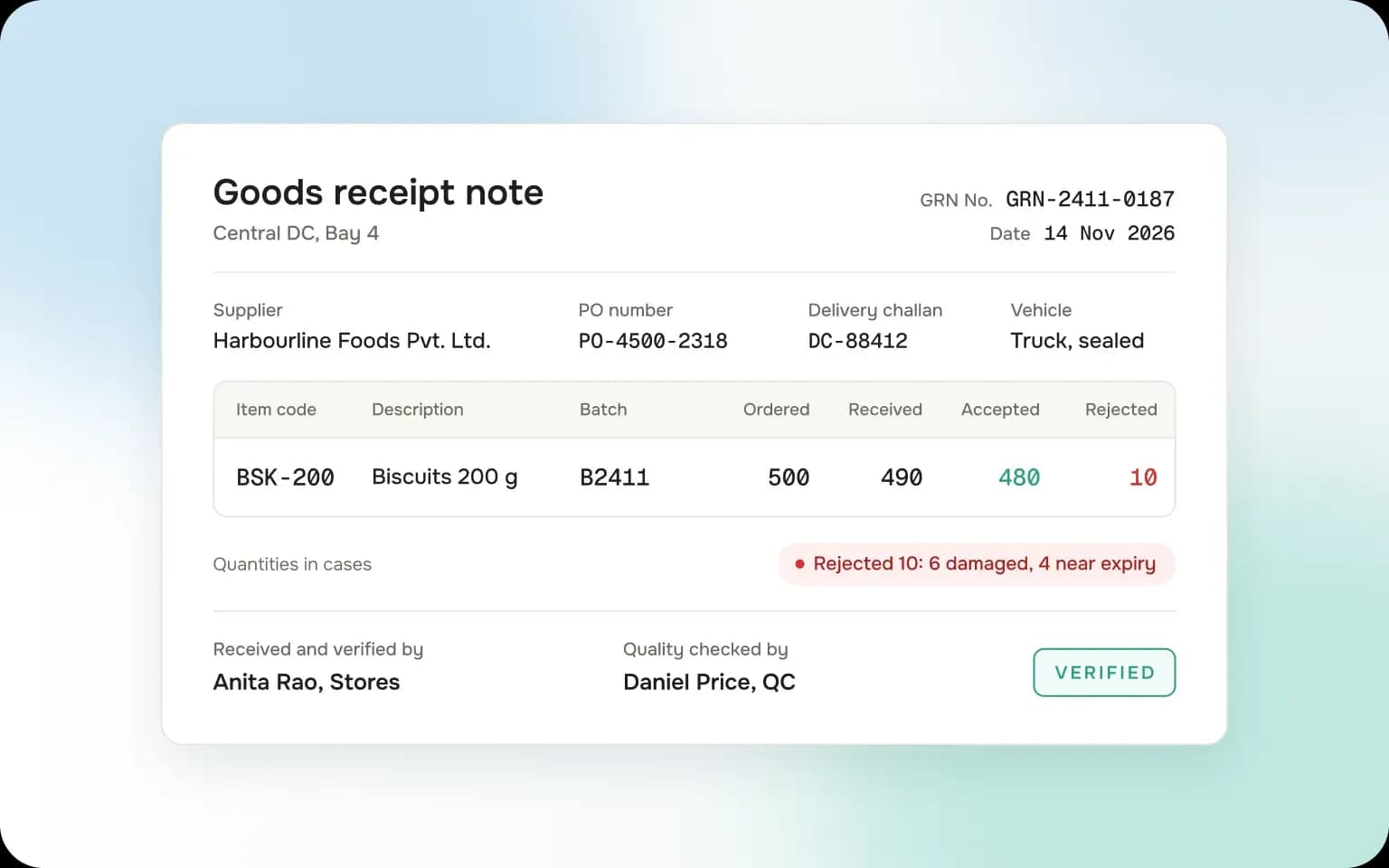
Most GRNs follow the same layout. The header holds the GRN number and date, supplier name and GSTIN, PO number, supplier invoice or challan number, vehicle and e-way bill number, and storage location. The body has one row per item. The footer records who received and verified the goods, with a signature or system login and the date.
Item code | Description | Batch | Expiry | MRP | Ordered | Received | Accepted | Rejected | Reason |
|---|---|---|---|---|---|---|---|---|---|
BSK-200 | Biscuits 200 g, | B2411 | Mar 2027 | ₹25 per | 500 | 490 | 480 | 10 | 6 damaged, |
This row is illustrative. Keep the four quantity columns on every line.
Goods Receipt Note Example
A food distributor orders 500 cases of biscuits at ₹480 a case (PO value ₹2,40,000). The truck arrives with 490 cases. During inspection, 6 cases are crushed and 4 are within 30 days of expiry, which breaks the buyer's shelf-life rule.
Line | Cases | Value (₹) |
|---|---|---|
Ordered (PO) | 500 | 2,40,000 |
Received | 490 | 2,35,200 |
Rejected (6 damaged, 4 near expiry) | 10 | 4,800 |
Accepted | 480 | 2,30,400 |
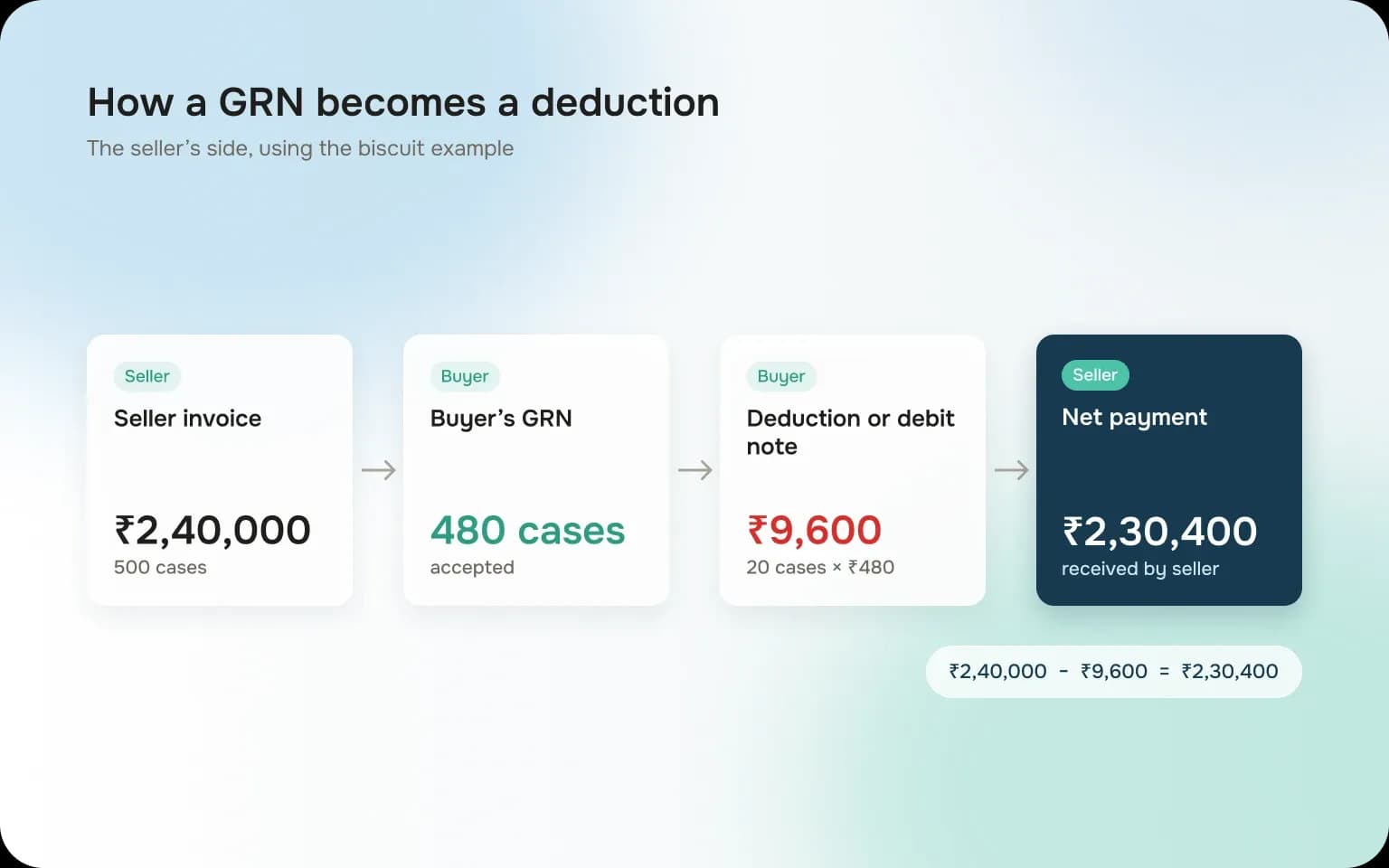
The GRN records 480 accepted cases. If the supplier invoices all 500 cases, accounts payable will flag a ₹9,600 gap: 10 cases never arrived and 10 were rejected. The buyer will pay ₹2,30,400 and raise a debit note for the rest. This is an illustrative example.
The GRN Process, Step by step
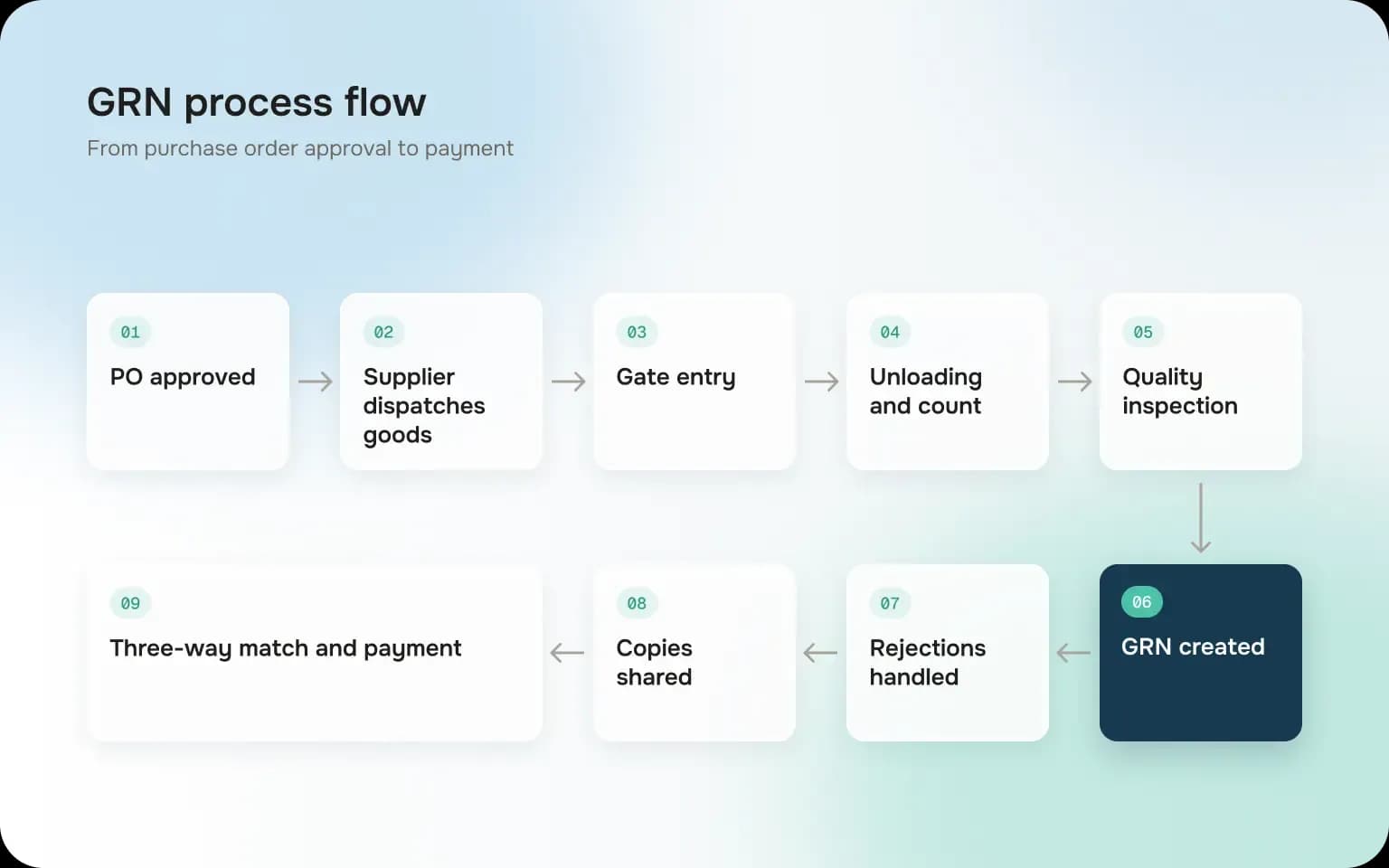
The GRN sits in the middle of the purchase order process. It comes after the supplier ships and before finance pays.
- Purchase order is approved and sent. The PO fixes the item, quantity, rate, delivery date and location. The GRN is checked against it.
- Supplier dispatches the goods. The truck carries the tax invoice or delivery challan, plus an e-way bill where required.
- Gate entry. Security logs the vehicle, arrival time and document numbers. Many buyers accept deliveries only in a booked appointment slot.
- Unloading and count. The receiving team counts cases or units and compares them with the PO and supplier documents.
- Quality inspection. The team checks damage, batch, expiry, MRP and specifications. Some goods go into a quality hold before acceptance.
- GRN is created. Received, accepted and rejected quantities are recorded line by line, with reasons. In an ERP, this posts stock and creates a provisional liability.
- Rejections are handled. Rejected goods go back to the supplier with a return document, and a debit note is raised where needed.
- Copies are shared. Procurement closes or updates the PO, accounts payable uses the GRN for matching, and the supplier often gets a copy as acknowledgement.
- Three-way match and payment. AP matches the invoice with the PO and GRN. If the numbers agree within tolerance, the invoice is approved for payment.
Partial, short and excess deliveries
Not every delivery matches the PO, and the GRN has to show that honestly:
- Partial delivery: Create a GRN for what arrived and keep the PO open for the balance.
- Short delivery: Record the actual quantity. Do not create the GRN for the PO quantity because 'the rest is coming'.
- Excess delivery: Accept only up to the PO quantity unless the buyer approves more. Return or hold the excess.
- Quality hold: Record the receipt, but keep the stock blocked until inspection clears it.
Timing matters as much as accuracy. A GRN created a week after the goods arrived delays the invoice match, pushes payments past MSME deadlines and makes the receipt date hard to defend.
GRN vs Purchase Order vs Invoice vs Delivery Challan
These four documents describe the same transaction from different points of view, which is why they disagree so often.
Document | Issued by | When | What it says |
|---|---|---|---|
Purchase order (PO) | Buyer | Before supply | What the buyer wants to buy, at what price |
Delivery challan | Supplier | With the goods | What the supplier says it sent |
Tax invoice | Supplier | With or after the goods | What the supplier is charging, including GST |
Goods receipt note (GRN) | Buyer | After inspection | What the buyer actually received and accepted |
A delivery challan cannot replace a GRN. The challan is the supplier's version of events. The GRN is the buyer's own count after inspection. When goods arrive damaged or short, the two will differ, and that difference is the reason a separate GRN exists.
A GRN is also different from proof of delivery (POD). The POD is signed by the receiver for the carrier or seller to confirm handover. The GRN is the buyer's internal record of what passed inspection. A signed POD does not guarantee a clean GRN. Read more in our guide to POD in the CPG industry.
The GRN's role in three way matching
In three-way matching, accounts payable compares three documents before paying:
- The purchase order: was this ordered, and at what rate?
- The goods receipt note: was it received, and how much was accepted?
- The supplier invoice: what is the supplier billing?
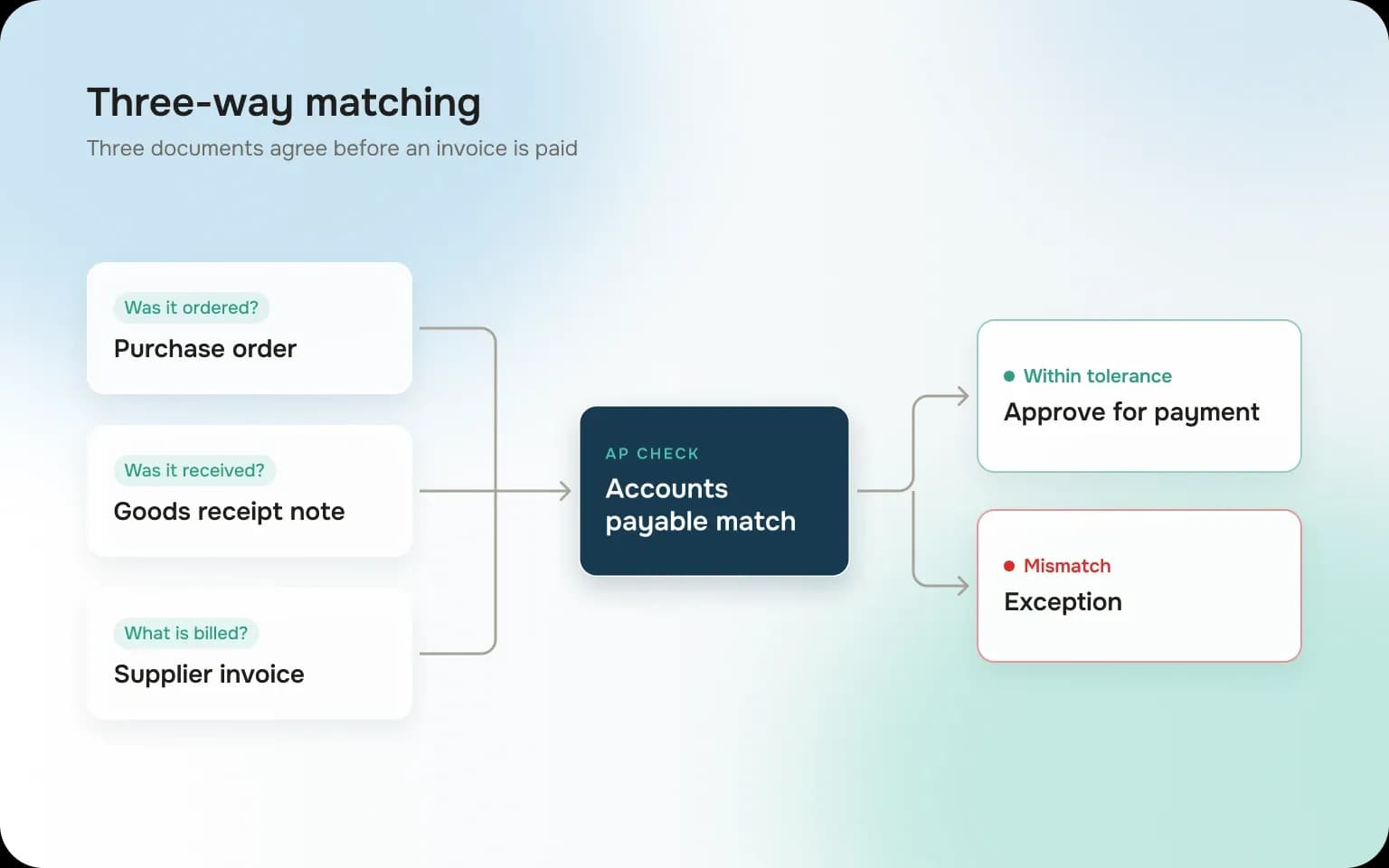
If quantity and price agree within the allowed tolerance, the invoice goes through without manual work. If not, it becomes an exception. Without a GRN, AP is matching the invoice against a promise (the PO), not against reality.
Exceptions are expensive. Ardent Partners' State of ePayables 2025 research puts the average invoice exception rate for AP departments at 18.4% and names exceptions as the biggest reason processing benchmarks stay high. Missing, late or inaccurate GRNs are a common cause, because the invoice has nothing reliable to match against.
The Seller's Side: How GRNs Turn Into Deductions
Most GRN guides are written for the buyer. For an FMCG or CPG brand selling to modern trade chains, distributors and quick commerce platforms, the more expensive problem sits on the other side: the customer's GRN decides what you get paid.
Here is how it typically works with large retail and quick commerce buyers, though terms vary by contract. Goods reach the buyer's distribution centre or dark store, the buyer creates its GRN, and its payables team validates the GRN against your invoice, allowing some tolerance for fill rate and short supply. It then applies the agreed deductions and pays the net amount.
So the gap between your invoice and their GRN becomes a deduction. The common reasons:
- Short receipt: The GRN shows fewer units than you invoiced, because of transit loss, a counting error at the dock or a mismatch in case packs.
- Damage and quality rejection: Crushed cases, leaks or failed quality checks are rejected at the dock.
- Shelf-life and MRP mismatch: Stock below the buyer's minimum shelf life, or with an MRP that differs from the PO, is rejected.
- Late or missed appointment: Deliveries outside the slot may be refused or partly accepted. See our guide on appointments in the CPG industry.
- Fill-rate penalties: Delivering less than the PO quantity can trigger penalties on top of the short payment. Read why a 90% fill rate may not be enough.
Why sellers lose money on GRN disputes
When a debit note arrives weeks later, the seller's finance team must match it line by line against the invoice, POD and dispatch records to prove it wrong. With hundreds of debit notes a month, most teams check only the large ones and write off the rest.
Those small write-offs add up. They are a classic source of revenue leakage in CPG. The fix is to treat every customer GRN and debit note as something to verify, not something to accept by default.
GRN in SAP, Tally and Oracle
Most Indian companies create GRNs inside their ERP, not on paper. The names differ, but the logic is the same.
GRN in SAP
In SAP, a GRN is called a goods receipt (GR) and is posted with transaction MIGO (or the Post Goods Movement app). For a receipt against a purchase order, SAP uses movement type 101. While posting, the user chooses whether stock goes into unrestricted use, quality inspection or blocked stock. A GR posting also creates an accounting entry, usually debiting inventory and crediting the GR/IR (goods received, invoice received) clearing account. When the invoice is booked, the GR/IR account clears. Open GR/IR balances show goods received but not yet invoiced, or invoiced but not yet received.
GRN in Tally
TallyPrime calls the GRN a Receipt Note. You can record a Receipt Note before the purchase invoice arrives, link it to the purchase order, and later book the purchase voucher against it using the tracking number. Rejected goods are recorded with a Rejections Out voucher. If a bill is booked before the goods arrive, it shows under 'Bills Recd. but Goods not Recd.' in the Purchase Bill Pending report, which is useful for month-end checks.
GRN in Oracle
In Oracle ERP, receipts are recorded in the Receiving module against purchase order shipments. The receipt routing decides what happens next: goods can go straight to the requester (direct delivery), into stock as a standard receipt, or into inspection before acceptance. Inspection records accepted and rejected quantities, and rejected goods can be returned to the supplier. Many setups also accrue the liability at receipt, so the books show goods received but not yet invoiced. Payables then matches the supplier invoice to the PO and the receipt (three-way), and to the inspection result where it applies (four-way). Menu names and options differ between Oracle E-Business Suite and Oracle Fusion Cloud, so follow your own configuration.
Accounting entry for a GRN
When goods are received before the invoice, most companies book a provisional liability so the books reflect the stock and the obligation:
- On GRN: Debit Inventory, Credit GR/IR or Goods Received Not Invoiced (GRNI)
- On invoice: Debit GR/IR or GRNI and Input GST, Credit the supplier account
For more on these entries, see our guide to accounts payable journal entries.
Common GRN Problems and How to Fix Them
Problem | What goes wrong | Fix |
|---|---|---|
Late GRN | Goods sit in the warehouse for days before the GRN is posted. Invoices wait, and MSME deadlines get missed. | Set a target (for example, GRN within 24 hours of unloading) and track it. |
GRN copied from the PO or invoice | The team books the ordered quantity instead of counting. Shortages surface only when stock runs out. | Make received quantity a mandatory, separately entered field. |
No rejection reasons | Rejections are recorded without a reason or photo. The supplier disputes the debit note. | Use fixed reason codes and attach photos for damage. |
Unit-of-measure mismatch | The PO is in cases, the invoice in units, the GRN in kilograms. Matching fails. | Standardise units in the item master and convert at receipt. |
GRN without a PO | Goods arrive with no approved PO. There is nothing to match against. | Enforce a 'no PO, no receipt' rule, with a tracked exception route. |
GRN best practices
- Count first, then look at the documents. A blind count prevents the team from simply copying the challan.
- Record four numbers per line: ordered, received, accepted and rejected.
- Capture evidence at the dock. Photos of damage, seals and labels settle disputes in minutes instead of weeks.
- Post the GRN the same day. It protects ITC timing, MSME deadlines and month-end accruals.
- Review GRNI or GR/IR balances monthly. Old open items usually point to missing invoices, wrong GRNs or duplicate bookings.
Automating GRN Matching and Deduction Checks
The business challange
The GRN connects the warehouse to finance, but in most companies that connection is manual. Buyers chase GRNs before they can approve invoices. Sellers receive customer debit notes based on GRNs they never see, and must match each claim to invoices, dispatch records and returns by hand. The result is slow payments on one side and unchecked deductions on the other.
How companies usually solve it
Most teams rely on ERP reports, spreadsheets and email. AP exports open POs and GRNs and matches invoices in Excel. On the sales side, AR teams download debit notes from customer portals and check only the largest ones. This works at low volume, but it breaks once invoices and debit notes run into the hundreds every week.
The automated approach
Finifi is operations AI for Order-to-Cash and Procure-to-Pay, built for consumer brands in India. It handles both sides of the GRN:
- For payables: Finifi's accounts payable automation reads invoices from PDFs, scans and e-invoices, and runs a line-level three-way match against the PO and GRN. Rate and quantity variances are flagged, and exceptions go to one workflow with comments and approvals. GST and MSME checks run alongside the match.
- For receivables: Finifi's debit note automation captures customer debit notes from email and buyer portals. It checks each shortage and damage claim against the GRN and dispatch records, rate claims against agreed prices, and return claims against the matching RTV. Duplicate claims are held, invalid deductions are disputed, and only approved notes sync to the ERP.
- Works with your ERP: Finifi connects with SAP, Oracle, Dynamics 365, Zoho and Tally, and typically goes live in about two weeks.
- People stay in control: Teams set approval rules, and a person signs off before money moves.
Consumer brands including Happilo, Bikaji, Jyothy Labs and Chheda's use Finifi.
If GRN mismatches are slowing your payables or eating into your receivables, talk to the Finifi team to see how it would work with your ERP and your customers.
Frequently Asked Questions
What is the full form of GRN?
GRN stands for Goods Receipt Note. It is also called a Goods Received Note. Both names refer to the same document: the buyer's record of goods received and accepted against a purchase order.
Who prepares a goods receipt note?
The buyer's receiving team prepares it. This is usually the stores, warehouse or distribution centre team, after counting and inspecting the delivery. The supplier does not create the GRN, though it often receives a copy.
What is the difference between a GRN and an invoice?
The invoice is issued by the supplier and states what it is charging. The GRN is issued by the buyer and states what was actually received and accepted. Accounts payable compares the two, along with the PO, before paying.
What is the difference between a delivery note and a GRN?
A delivery note or challan comes from the supplier and lists what was sent. A GRN comes from the buyer and lists what arrived and passed inspection. If goods are damaged or short, the two documents will not match.
Is a GRN mandatory under GST?
No. GST rules prescribe documents such as the tax invoice, delivery challan and e-way bill, not the GRN. However, ITC is allowed only after goods are received, so a dated GRN is strong evidence of receipt during an audit.
Can a GRN be reversed or cancelled?
Yes. ERPs allow a goods receipt to be reversed if it was posted in error. In SAP, a goods receipt against a PO is usually reversed with movement type 102. The reversal should be documented, because it changes stock and the liability.
What is GRNI?
GRNI means Goods Received Not Invoiced. It is the liability a company books when goods have arrived, and a GRN is posted, but the supplier's invoice has not yet been recorded. It clears when the invoice is booked.