Financial Credit Note Under GST: Rules, IMS Impact and FMCG Examples
When to use a financial credit note or a GST credit note for FMCG schemes, how IMS rejections affect your GST, and what changed on 1 November 2026.
Punithkumar
19 NOV 2026 · 15 min read

A financial credit note under GST is a commercial credit that reduces what a customer owes you without changing the GST on the original invoice. FMCG brands issue them all the time for target incentives, scheme payouts and trade discounts to distributors and modern trade. Choosing between a financial credit note and a GST (tax) credit note decides whether GST is adjusted on the discount and, under the Invoice Management System (IMS), whether your customer has to act on the note at all.
The rules changed twice recently. Since 1 October 2025, a supplier can reduce GST on a credit note only if the buyer reverses the matching input tax credit. From 1 November 2026, post-sale discounts no longer need a prior agreement to be adjusted through a GST credit note.
TL;DR: A financial (commercial) credit note reduces the amount payable but not the GST already charged. The supplier's GST liability stays the same, and the buyer keeps its full input tax credit. A tax credit note under Section 34 reduces both value and GST, but only works if the buyer accepts it in IMS and reverses the ITC. If the buyer rejects it, the GST is added back to the supplier's liability.
What Is a Credit Note Under GST?
Under GST, there are two kinds of credit note, and they behave very differently.
Tax credit note (Section 34)
A tax credit note, often just called a GST credit note, is issued under Section 34 of the CGST Act. It reduces both the taxable value and the GST on an earlier invoice. A supplier can issue one when:
- The invoice value or tax charged was higher than it should have been
- The buyer returned goods
- The goods or services were found deficient
- From 1 November 2026, a post-supply discount under Section 15(3)(b) was given (details below)
The supplier reports the tax credit note in GSTR-1, and it reaches the buyer's IMS dashboard. Since 1 October 2025, the supplier can reduce its output tax only if the registered buyer has reversed the ITC attributable to that credit note. This rule came from Section 126 of the Finance Act, 2025.
Financial credit note (commercial credit note)
A financial credit note, also called a commercial credit note or a credit note without GST, only adjusts the money owed. It does not change the taxable value or GST on the original invoice. It is not a Section 34 document, so it is not reported in GSTR-1 and does not appear in the buyer's IMS.
CBIC allowed this route in Circular 92/11/2019-GST (7 March 2019) for secondary discounts that do not qualify for a GST reduction. Circular 251/08/2025-GST (12 September 2025) then confirmed that when a discount is given through a financial credit note, the buyer does not have to reverse ITC. The supplier's GST stays as invoiced, so the buyer's credit stays as claimed.
In plain terms: a tax credit note adjusts GST on both sides, and a financial credit note leaves GST on both sides untouched. Done correctly, neither route is a loss.
Financial Credit Note Under GST vs Tax Credit Note
Basis | Tax credit note (Section 34) | Financial credit note |
|---|---|---|
What it changes | Taxable value and GST | Amount payable only |
Supplier's GST liability | Reduced, if the buyer reverses ITC | Unchanged |
Buyer's ITC | Must be reversed | Kept in full |
Reported in GSTR-1 | Yes (credit note tables) | No |
Appears in buyer's IMS | Yes, buyer can accept, reject or keep pending | No |
E-invoice (IRN) | Needed if the supplier is under e-invoicing | Not needed |
Time limit for GST effect | 30 November after the financial year, or annual return date if earlier | No GST time limit (commercial document) |
Typical FMCG use | Returns, rate differences, short supply, post-sale discounts (from 1 Nov 2026) | Target incentives, scheme payouts and discounts where the GST is left untouched |
A worked example
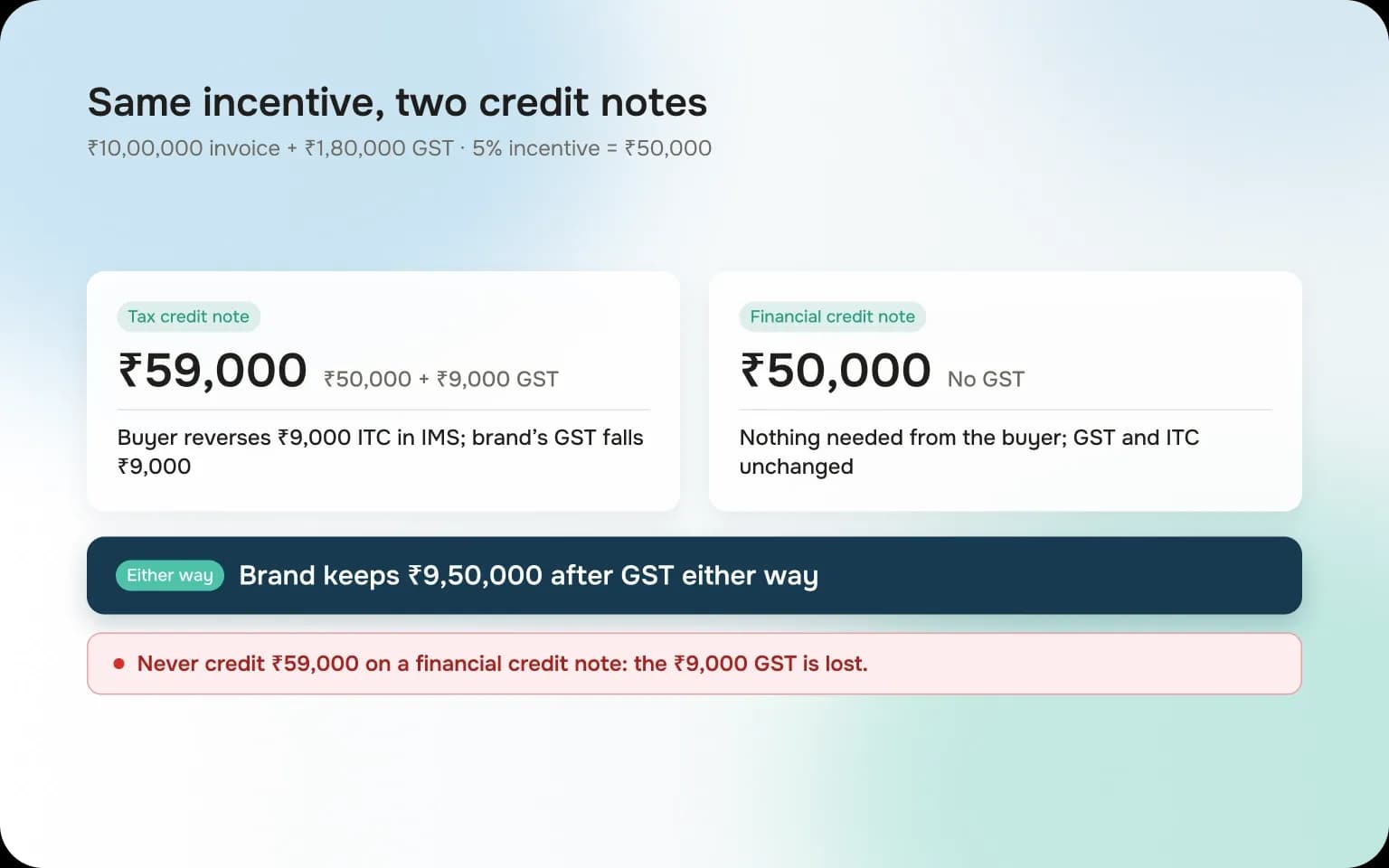
A brand sells goods worth ₹10,00,000 to a distributor, plus 18% GST of ₹1,80,000. At quarter end, the distributor hits its target and earns a 5% incentive of ₹50,000.
- Tax credit note: The brand issues a credit note for ₹50,000 plus ₹9,000 GST. If the distributor accepts it in IMS and reverses ₹9,000 of ITC, the brand's output GST falls by ₹9,000. The distributor's net payable falls by ₹59,000.
- Financial credit note: The brand issues a credit note for ₹50,000 with no GST. The brand's output GST stays at ₹1,80,000, and the distributor keeps its full ₹1,80,000 of ITC.
Either way, the brand keeps ₹9,50,000 after GST, and the distributor's net cost is also the same. Under the tax credit note, the brand collects ₹59,000 less and pays ₹9,000 less GST. Under the financial credit note, it collects ₹50,000 less and its GST is unchanged.
The real difference is effort and risk. The tax credit note works only if the distributor accepts it in IMS and reverses its ITC. The financial credit note needs nothing from the distributor. The one way to lose money is to issue a financial credit note for ₹59,000, the discount plus GST: the brand then gives away GST it can never recover. This is an illustrative example.
When FMCG Brands Use Each Type
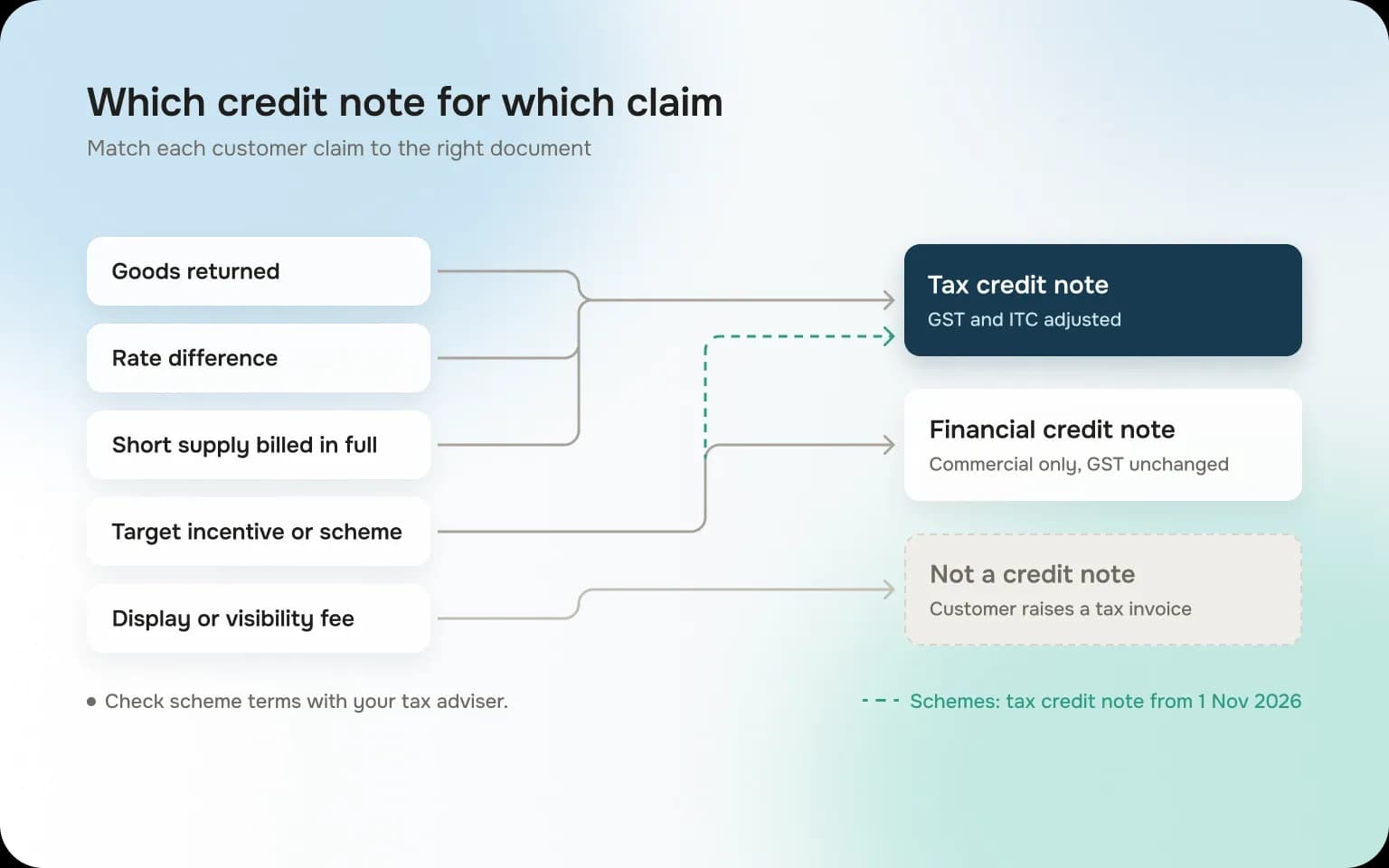
FMCG brands settle many claims every month with distributors, modern trade chains and quick commerce platforms. Here is how the common ones usually map:
Situation | Usual document | Why |
|---|---|---|
Goods returned (damaged, expired, unsold) | Tax credit note | A listed Section 34 ground. Using a financial credit note here can put the buyer's ITC on the returned goods at risk |
Rate difference or price drop on billed stock | Tax credit note | The invoice value was higher than payable |
Short supply billed in full | Tax credit note | The value invoiced exceeded what was supplied |
Target incentive, quantity scheme, slab discount | Tax credit note (from 1 Nov 2026) or financial credit note | Depends on whether you want to reduce GST and can rely on buyer ITC reversal |
Display, visibility or co-branding fees agreed with a fixed amount | Not a credit note: the customer raises a tax invoice for the service | Circular 251 treats explicitly agreed promotional services as a separate supply |
Post-Sale Discounts: What Changed on 1 November 2026
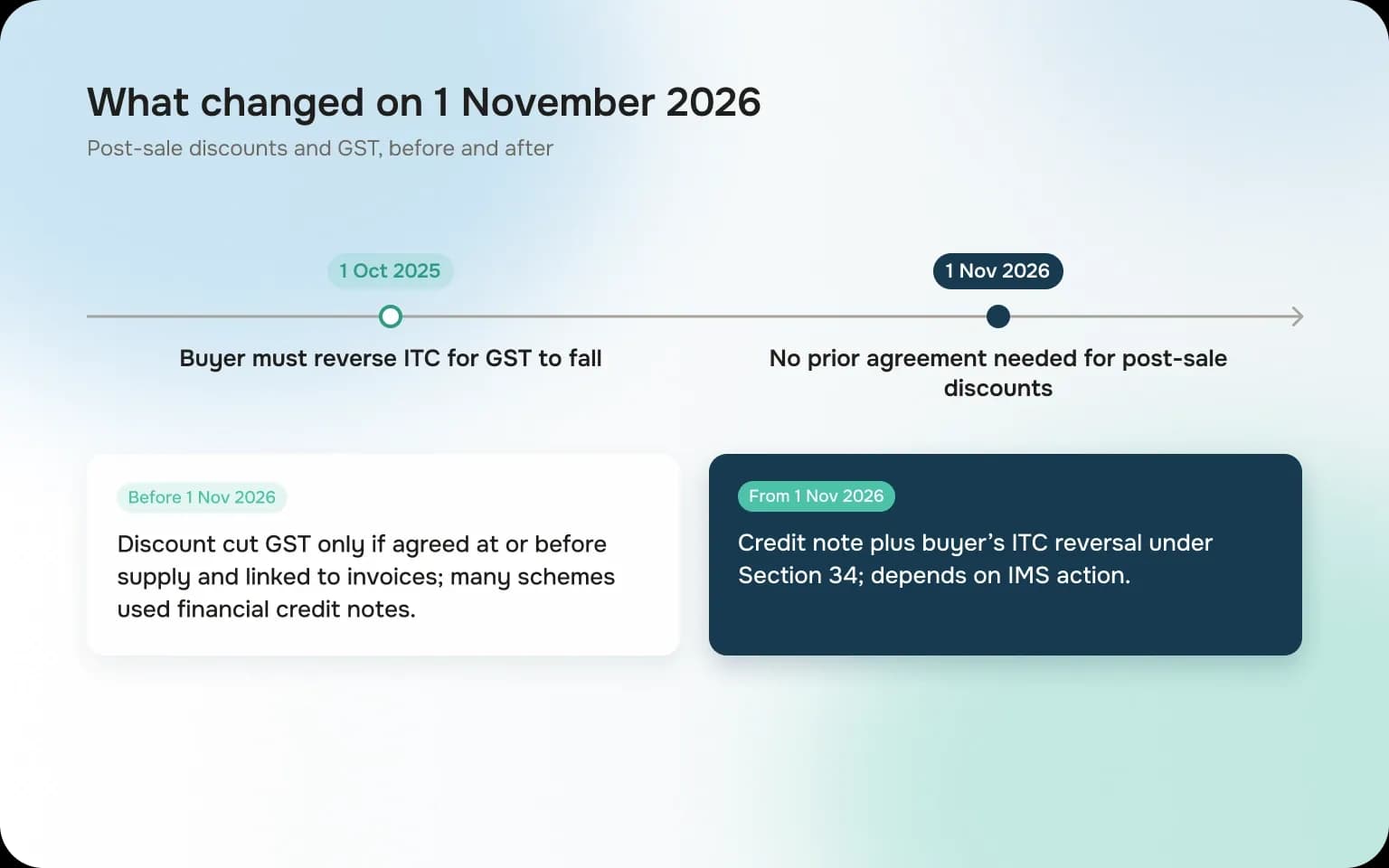
Before 1 November 2026, a post-sale discount could reduce GST only if it was set out in an agreement made at or before the supply and linked to specific invoices. Many FMCG schemes (quarterly targets, festive schemes announced mid-season) failed that test, so brands settled them with financial credit notes and left GST as invoiced.
Section 153 of the Finance Act, 2026 rewrote Section 15(3)(b). Now a post-sale discount is excluded from taxable value if the supplier issues a credit note for it and the buyer reverses the matching ITC under Section 34. Section 34(1) was also amended to list this discount as a ground for a credit note. Both changes took effect on 1 November 2026 through Notification No. 03/2026-Central Tax.
Schemes that once had to go through financial credit notes can now carry a GST reduction, as long as the buyer reverses its ITC. The trade-off is work: every such credit note now depends on the customer's action in IMS.
Discounts and the dealer's own sales
Circular 251/08/2025-GST also clarified that a manufacturer's post-sale discount to a dealer is not extra consideration for the dealer's onward sale, unless the manufacturer has agreed a discounted price with the end customer. GST on promotion applies only when a service is explicitly agreed with a clearly defined consideration.
Check each scheme's terms with your tax adviser before changing your process.
How IMS Treats Credit Notes
What happens if a buyer rejects a credit note
The Invoice Management System (IMS) is the GST portal dashboard where a buyer reviews documents its suppliers have reported in GSTR-1, GSTR-1A or IFF. For each one, the buyer can accept, reject or keep it pending. For invoices, the buyer's action mainly affects its own ITC. For credit notes, the buyer's action also changes the supplier's GST liability.
Buyer's action on a tax credit note | Effect on supplier | Effect on buyer |
|---|---|---|
Accept | Output GST reduced by the credit note | ITC reduced in GSTR-3B |
Reject | Credit note's GST added back to liability | ITC not reduced |
Pending | Decision deferred; must be resolved in the next period | ITC not reduced yet |
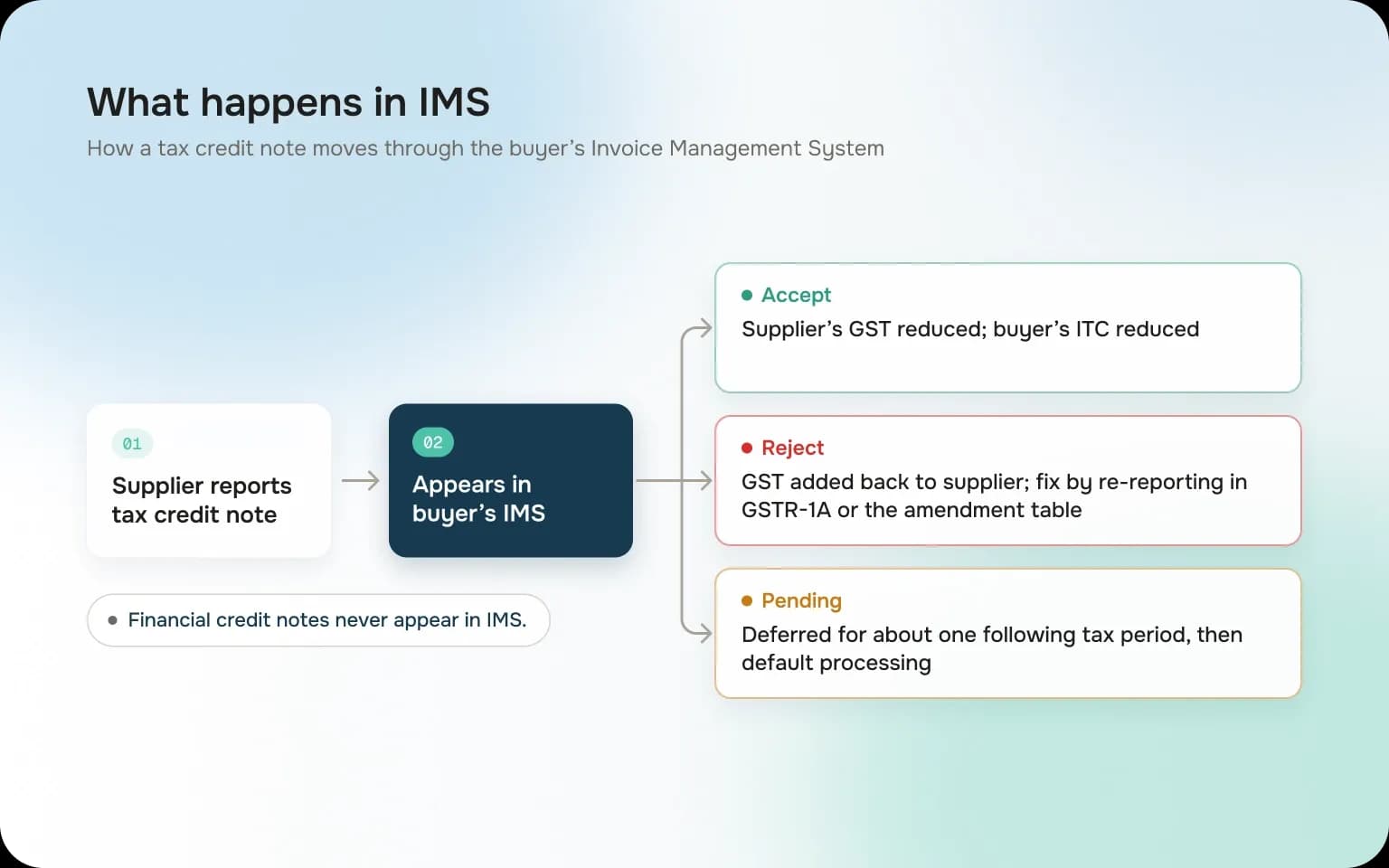
GSTN's advisory of 19 June 2025 puts it simply: a supplier can reduce GST on a credit note only when the buyer accepts it. If a buyer rejects a valid credit note by mistake, the supplier can report the same credit note again in GSTR-1A, or in the amendment table of a later GSTR-1 or IFF. Once the buyer accepts it, the liability falls again.
The October 2025 changes
GSTN made two changes from October 2025 that matter for credit notes:
- Pending is now allowed for credit notes, but only for about one following tax period: a month for monthly filers, a quarter for quarterly filers. After that, the record follows default processing.
- The buyer can declare how much ITC to reverse. Earlier, the full GST on a credit note could be reversed even if the buyer had claimed less (or no) ITC on the original invoice. Now the buyer can enter the actual amount, backed by its records.
Why this matters for FMCG brands
A large brand may issue hundreds of credit notes a month across distributors, modern trade and quick commerce. Under IMS, each tax credit note becomes a task for the customer. Every rejection adds GST back to the brand's liability until it is resolved.
Financial credit notes don't go through IMS at all, which makes them simpler for both sides. Brands now need a clear policy on which claims go through which route, and a way to track every tax credit note until the customer accepts it.
Time Limits, Reporting and Accounting Entries
Time limit for a tax credit note
A tax credit note must be declared in GSTR-1 no later than 30 November after the end of the financial year of the original supply, or the date of filing the annual return, whichever is earlier. For a supply in FY 2025-26, the deadline is 30 November 2026. After that, you can still settle the amount commercially, but the GST reduction is lost. Some older guides still give a September deadline; the Finance Act, 2022 moved it to 30 November. Keep credit note records for 72 months from the due date of the annual return.
What a tax credit note must contain
Rule 53 of the CGST Rules sets out the details a tax credit note must carry:
- The words "Credit Note" and a serial number of up to 16 characters, unique for the financial year
- Date of issue
- Supplier's and buyer's name, address and GSTIN
- The original invoice number and date
- Taxable value, GST rate and tax amount being reduced
- Signature or digital signature of the supplier
The credit note should carry the same GST rate as the original invoice, even if the rate has changed since. This matters for FMCG goods whose rates changed in September 2025. If the supplier is under e-invoicing, the tax credit note also needs an IRN from the Invoice Registration Portal. A financial credit note has no GST format, but it should still reference the scheme, the period and the invoices or claims it settles, so both sides can reconcile it.
Accounting entries
For the supplier, using the ₹50,000 incentive example above:
- Tax credit note: Debit Sales or Discount Allowed ₹50,000 and Output GST ₹9,000. Credit the customer account ₹59,000.
- Financial credit note: Debit Discount Allowed or Scheme Expense ₹50,000. Credit the customer account ₹50,000. Output GST is untouched.
For the buyer, a tax credit note reduces purchases (or records a discount received) and reverses ₹9,000 of ITC. A financial credit note is booked as income or a purchase discount, with ITC left as it is. Clear entries on both sides make month-end accounts receivable reconciliation much easier.
Common Mistakes and Best Practices
Mistakes that cost FMCG brands money
- Issuing tax credit notes without checking the claim. A customer's deduction or debit note is not proof. If you issue a tax credit note for a claim that doesn't match the agreed scheme, you may lose the money and face a GST question later.
- Not tracking IMS rejections. A rejected credit note quietly adds GST back to your liability in a later GSTR-3B. Without a monthly check, nobody notices until the reconciliation goes wrong.
- Missing the 30 November deadline. Year-end scheme settlements often run late. Once the deadline passes, the GST benefit is gone.
- Crediting GST on a financial credit note. If you credit the discount plus GST but leave your output GST unchanged, you give away tax you cannot recover. Credit only the pre-GST amount.
- Calling a service fee a discount. If a customer charges you for display or visibility under an agreement with a fixed fee, that is usually a service they must invoice with GST, not a credit note you issue.
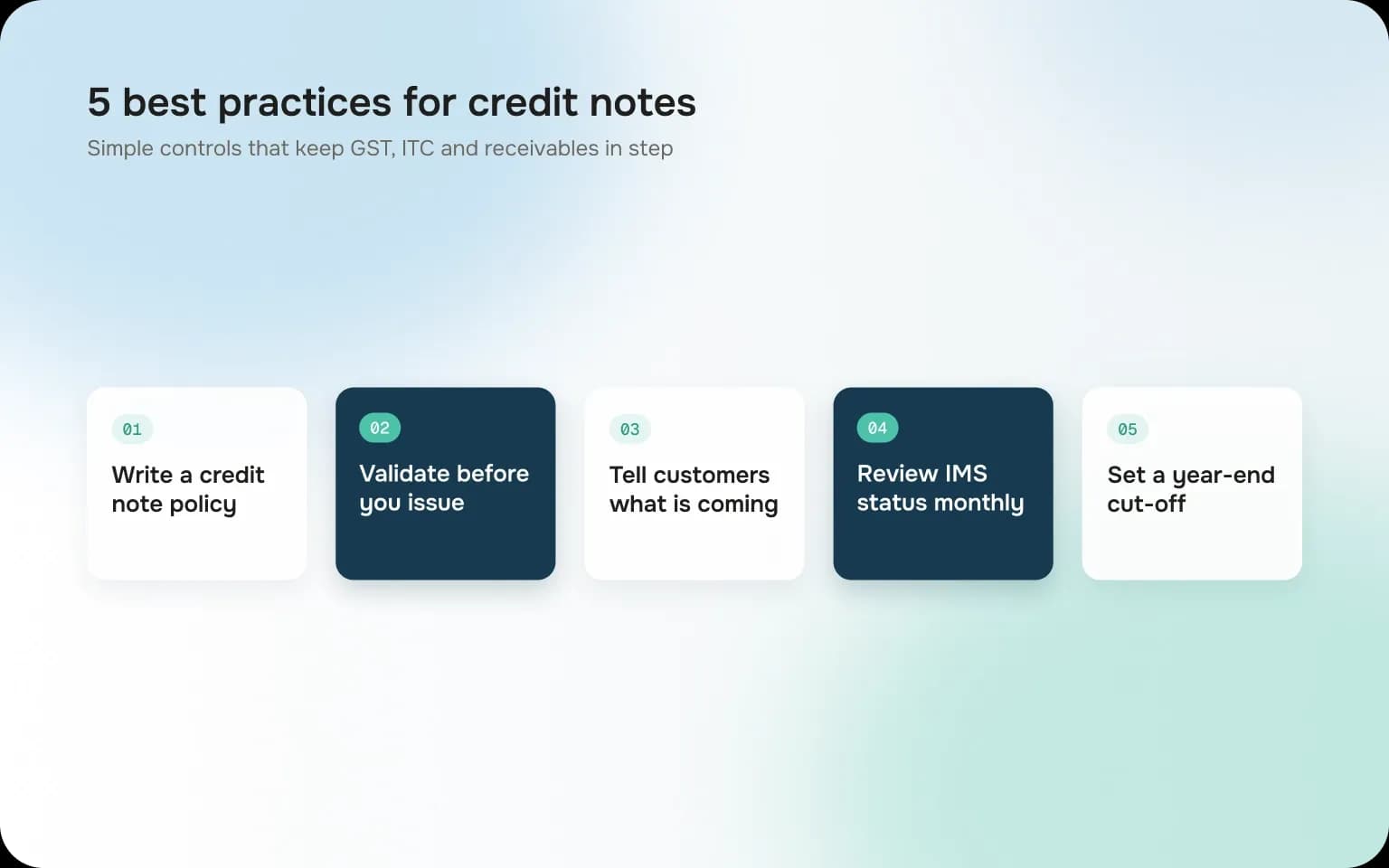
Best practices
- Write a credit note policy. List each claim type and the document it gets.
- Validate before you issue. Check every claim against the scheme terms, invoices, dispatch records and proof of delivery before a credit note goes out.
- Tell customers what is coming. Share credit note details before they reach IMS, so customers accept rather than reject.
- Review IMS status monthly. Track every tax credit note until accepted, and re-report wrongly rejected ones quickly through GSTR-1A or the amendment table.
- Set a year-end cut-off. Close scheme calculations well before 30 November so tax credit notes can still be issued in time.
Automating Customer Claims and Credit Notes
The challenge: credit notes issued on unverified claims
Every credit note an FMCG brand issues starts as a claim: a customer debit note, a deduction from a payment, or a scheme payout. Finance must decide whether each claim is valid, what it is for, and whether it should become a tax credit note, a financial credit note or a dispute. Since IMS, a wrong call also shows up in the brand's GST liability.
How teams handle customer claims today
Most teams download claims from customer portals into spreadsheets. They check the large ones against invoices and scheme letters and accept the small ones to save time. Tracking whether each tax credit note was accepted in IMS is usually a separate, manual exercise, if it happens at all. Small unchecked claims add up to real revenue leakage.
The automated approach to claim validation
Finifi is operations AI for Order-to-Cash and Procure-to-Pay, built for consumer brands in India. Its debit note automation validates customer claims before any credit note is issued:
- Captures every claim from email and buyer portals and reads it into structured data.
- Checks each claim against your records: shortage and damage claims against the GRN and dispatch, rate claims against the agreed price for that period, and return claims against the matching return record.
- Routes scheme and promotion claims for review against the scheme agreed with that customer, and holds duplicate claims on the same invoice line.
- Disputes invalid deductions and syncs only approved notes to your ERP, including SAP, Oracle, Dynamics 365 and Tally.
- Keeps people in control, with approvals routed by amount, customer, reason or risk.
The result: credit notes are issued only for claims you have verified, which gives customers fewer reasons to reject them and gives your team a clear trail for every one. Consumer brands including Happilo, Bikaji, Jyothy Labs and Chheda's use Finifi.
If customer claims and credit notes are taking up your finance team's month, talk to the Finifi team to see how it would work with your customers and your ERP.
Frequently Asked Questions
What is a financial credit note under GST?
A financial credit note, also called a commercial credit note, reduces the amount a customer owes without changing the taxable value or GST on the original invoice. It is not issued under Section 34, is not reported in GSTR-1 and does not appear in the buyer's IMS.
Does the buyer need to reverse ITC on a financial credit note?
No. Circular 251/08/2025-GST clarifies that when a discount is given through a financial or commercial credit note, the recipient does not have to reverse the input tax credit, because the supplier's GST on the original invoice is not reduced.
Should a financial credit note carry GST?
No. A financial credit note is issued for the commercial amount only. If you want to reduce GST along with the value, you need a tax credit note under Section 34, which requires the buyer to reverse the matching ITC.
What happens if a buyer rejects a credit note in IMS?
The GST on the rejected credit note is added back to the supplier's output tax liability. If the rejection was a mistake, the supplier can report the same credit note again in GSTR-1A or the amendment table of a later GSTR-1 or IFF, and the liability falls once the buyer accepts it.
What is the time limit for issuing a GST credit note?
A tax credit note must be declared in GSTR-1 by 30 November after the end of the financial year in which the supply was made, or the date of filing the annual return, whichever is earlier. After that, only a financial credit note can be issued.
Can post-sale discounts be adjusted through a GST credit note?
Yes. From 1 November 2026, a post-sale discount can be excluded from taxable value through a GST credit note without a prior agreement or invoice linkage, as long as the buyer reverses the attributable ITC under Section 34.
What is the difference between a debit note and a credit note in GST?
A credit note reduces the value or tax of an earlier invoice, for example after returns, rate differences or discounts. A debit note increases it, for example when the invoice was undercharged. Both must reference the original invoice and be reported in GST returns.