Inside India’s Billion-Dollar Perfume Industry: The Fragrance Revolution
16 JUN 2026 · Updated 2 NOV · 16 min read

Before there were glass bottles with French names on perfume counters, before aerosol cans hissed in bathroom cabinets, before any of the modern language around fragrance existed in India, there was Kannauj.
Under the Mughal Empire, Kannauj became the primary fragrance supplier for royal courts. Emperor Harshvardhan in the 7th century reportedly taxed vetiver grass because of its high value in perfumery (Source: Scento, 2026). The fragrances produced were not simple. Rose attar distillation can take 12 to 15 hours per batch, and the complete product including aging can require several months to ten years of maturation (Source: Smytten Blog, 2026).
India was not borrowing perfumery from the French. It was one of the cultures that invented it.
And then colonisation happened. British rule brought European alcohol-based perfumes into fashion among urban Indians and the aristocracy. Status-conscious Indians eager to present themselves as modern shifted allegiance toward imported Western fragrances (Source: National Geographic). Post-independence, cheap aerosol body sprays completed the job that colonisation had started. Urban consumers moved to alcohol-based products. A civilisation that had been making world-class perfume for three millennia ended up buying mass-market body sprays from multinationals.
That is where the modern story begins.
One Spray Can, One Brand
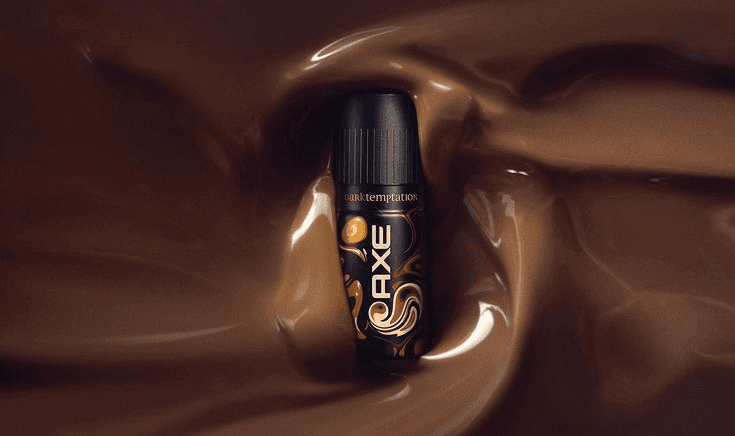
In 1999, Hindustan Unilever launched a male grooming product in India that would define how an entire generation of urban Indians thought about fragrance. It came in an aerosol can. It was positioned as an instrument of seduction for young men. Its tagline became cultural shorthand. And it worked so completely that for nearly a decade, the organised fragrance market in India was essentially one product category, one gender and one use case.
The deodorant market in India was worth Rs 500 crore by 2009, growing at over 40% annually at its peak (Source: Business Standard, 2013). The success of this single product attracted competition, but on identical terms: aerosol sprays, male-oriented, priced for mass-market accessibility, sold on fragrance intensity and duration. The category expanded but did not diversify. Spray deodorants were the market.
What this created, almost accidentally, was a structural gap. Women were largely ignored by a category built entirely around male consumer identity. Premium fragrance, niche perfumery and traditional formats had no organised presence in modern retail. Roll-ons, the dominant deodorant format in most of Europe, had negligible market share. And the idea that an Indian consumer might spend serious money on a personal fragrance as an expression of identity rather than a hygiene product was not on anyone’s marketing brief.
That gap is precisely what the next fifteen years of market evolution has filled, and the scale of what has grown in that space is remarkable.
The Market Finally Has Numbers
The combined perfumes and deodorants market in India reached USD 2,601.2 million in 2024 and is projected to reach USD 6,727.6 million by 2033, growing at a CAGR of 11.14% (Source: IMARC Group, 2026). To put that in context, this is a market that is expected to nearly triple in under a decade.
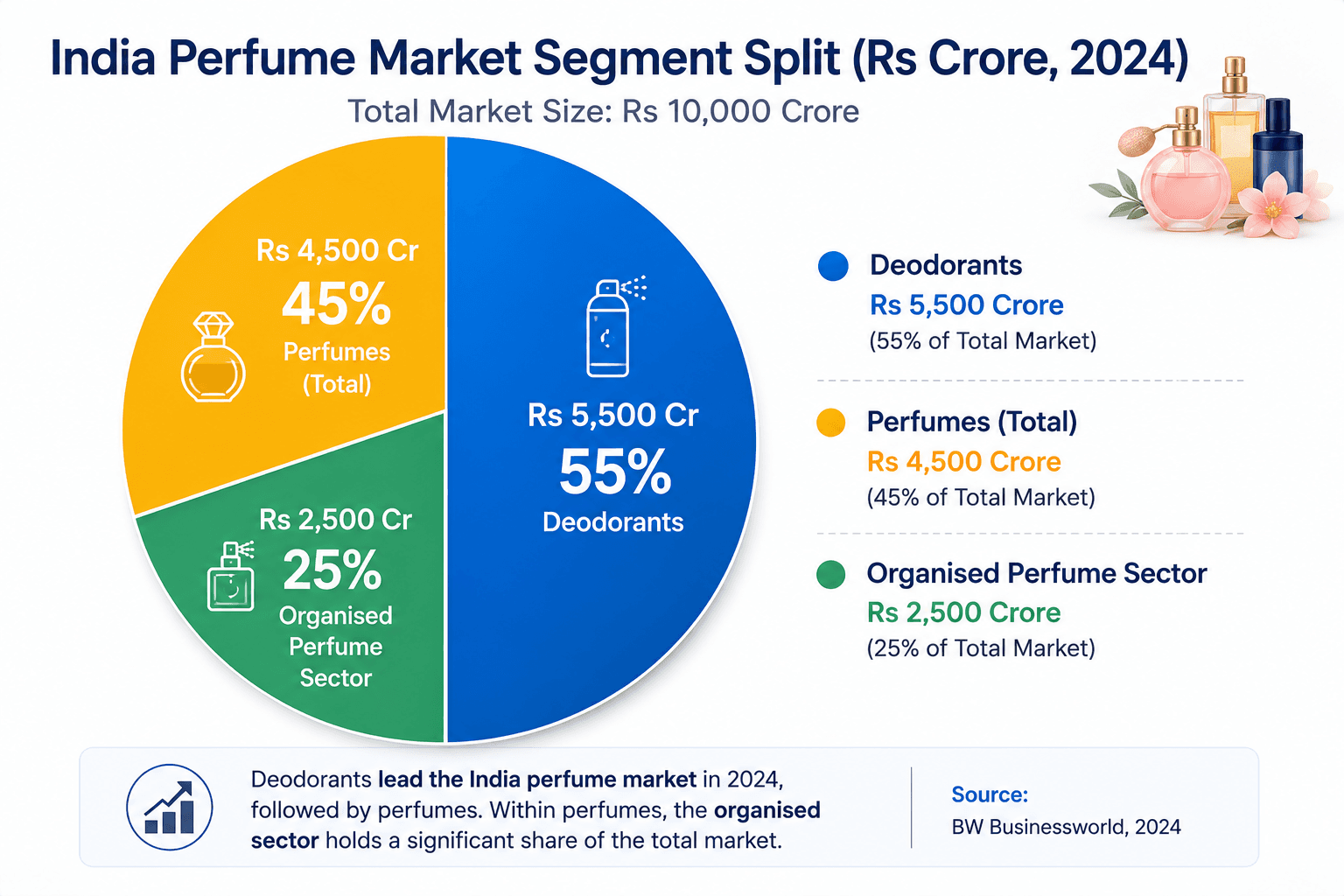
Breaking it down in rupee terms gives a clearer picture of the domestic scale. The Indian perfume and deodorant market is valued at roughly Rs 10,000 crore, with perfumes accounting for Rs 4,500 crore and deodorants at Rs 5,500 crore. Of the perfume segment, the organised sector is estimated at approximately Rs 2,500 crore (Source: BW Businessworld, 2024). A significant portion of the perfume market still operates through informal and unorganised channels, particularly in the attar and itr segment.
The deodorant sub-segment specifically was valued at USD 1,019 million in 2024 and is expected to reach USD 1,603.61 million by 2033 at a CAGR of 5.21% (Source: Deep Market Insights, 2025). The perfume segment alone was valued between USD 1,184 million and USD 2,354.3 million in 2024 depending on the scope of the estimate, and is projected to grow at a CAGR of 5.36% to 9.6% through 2030 to 2034 (Source: IMARC Group 2026, Grand View Research 2026).
At the global level, the fragrance market was valued at USD 29.19 billion in 2024 and is projected to reach USD 58.89 billion by 2032 at a CAGR of 9.17% (Source: EIN Presswire, 2025). Asia Pacific is the fastest-growing region globally, and India is a primary driver of that growth.
Chart Data Reference 1: India Perfumes and Deodorants Market (USD Million)
- 2024: $2,601.2M
- 2025 (est): $2,890M
- 2033 forecast: $6,727.6M
- CAGR: 11.14% (Source: IMARC Group, 2026)
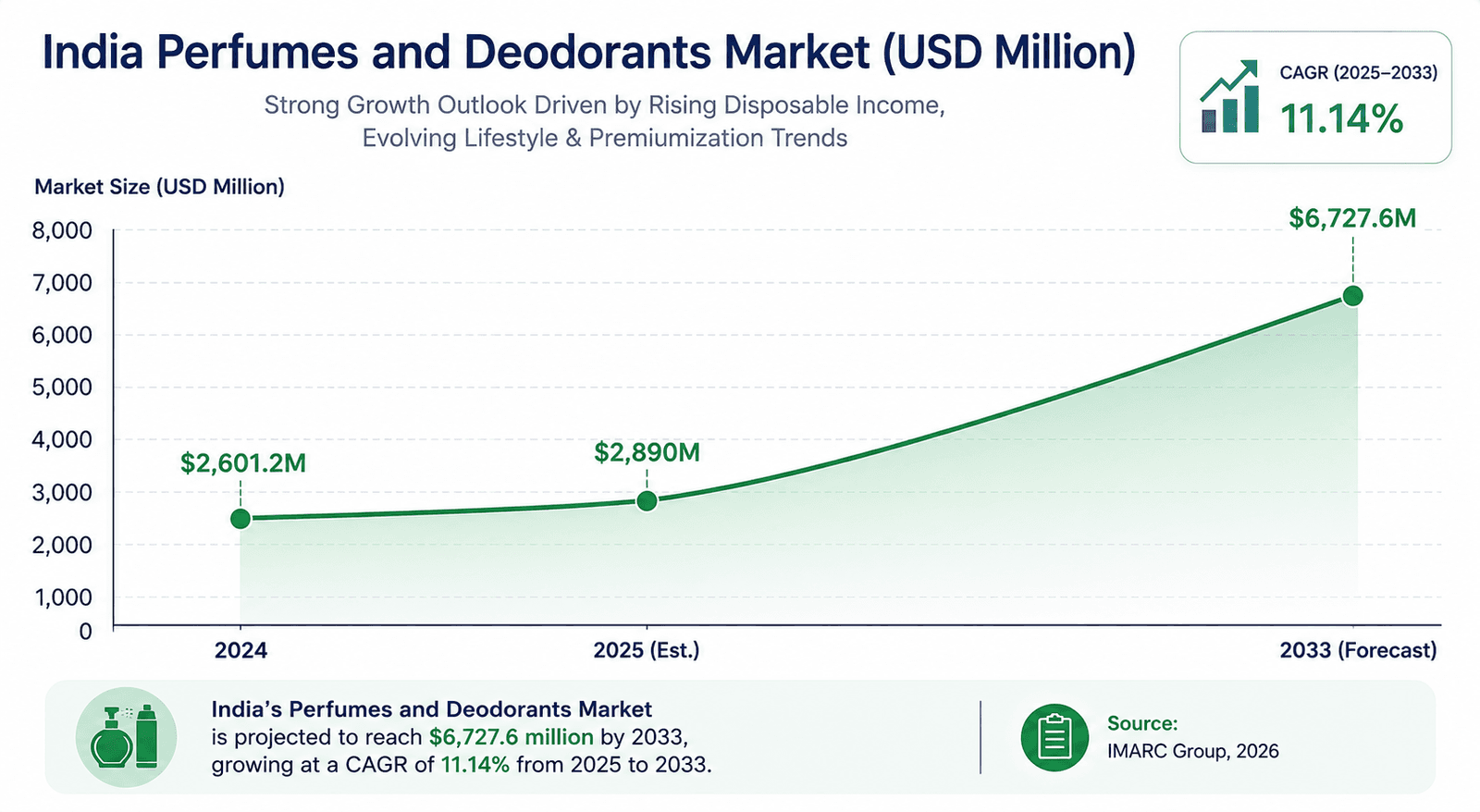
Chart Data Reference 2: India Deodorant Market by Format Share (2024)
- Spray/Aerosol: dominant share
- Roll-on: fastest-growing format
- Stick: niche but growing (Source: Deep Market Insights 2025, Accio.com 2026)
Chart Data Reference 3: India Perfume Market Segment Split (Rs Crore, 2024)
- Total market: Rs 10,000 crore
- Deodorants: Rs 5,500 crore
- Perfumes (total): Rs 4,500 crore
- Organised perfume sector: Rs 2,500 crore (Source: BW Businessworld, 2024)
Three Products, Three Consumers
The single most important structural development in India’s fragrance market over the last decade is bifurcation. What was once a single undifferentiated category of body sprays for men has separated into at least three distinct product conversations, each with its own consumer profile, purchase motivation and competitive landscape.
The first is the deodorant segment: mass-market, sweat-and-odour-focused, driven by hygiene awareness, available at every kirana and pharmacy, and bought largely on price and fragrance intensity. This is the most penetrated segment, dominated by spray formats, and the competitive battleground is value: more fragrance for less money, longer-lasting protection, no-gas formulations that do not empty the can in five uses.
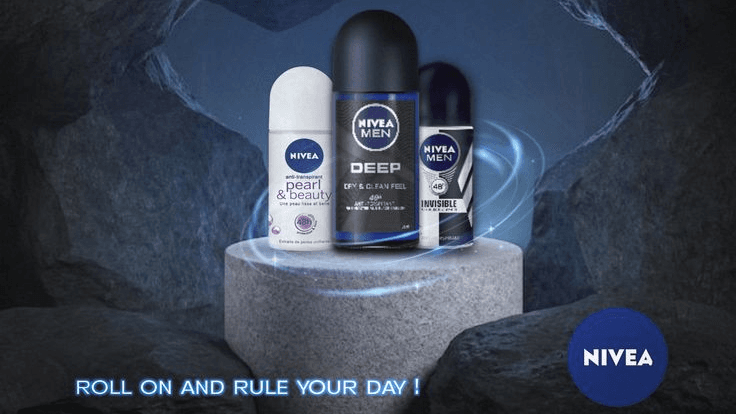
The second is the roll-on segment, which is quietly staging one of the more interesting consumer transitions in Indian personal care. Roll-ons were historically a niche format in India, perceived as the option for people who had sensitive skin or could not tolerate aerosol sprays. That perception has inverted. Roll-ons are now the fastest-growing deodorant format in the country (Source: Deep Market Insights, 2025), driven by a different kind of consumer: women, primarily, who are looking for aluminium-free formulations, skin-safe ingredients, moisturising actives and products that feel like skincare rather than hygiene maintenance. The “skinification” of deodorants, where products incorporate vitamin B3, vitamin E, hyaluronic acid and other skincare ingredients alongside odour protection, is being led almost entirely by the roll-on format. In May 2024, one international personal care company introduced whole body deodorant formulations in India that were aluminium-free, enriched with vitamins and dermatologist-tested for 72-hour protection (Source: IMARC Group, 2026). That product would not exist if there was not a ready, waiting consumer for it.

The third is the perfume segment proper: Eau de Parfums, Eau de Toilettes, concentrated parfums and body mists positioned as identity products rather than hygiene products. The consumer here is buying a scent the way they buy a watch or a handbag. It is personal, it is aspirational and it has nothing to do with sweat management. This consumer is younger than most FMCG marketers expected, significantly female, and far more willing to spend than the mass deodorant buyer. The premium perfume segment is now the fastest-growing price tier in the Indian perfume market, outpacing the mass segment in percentage growth terms (Source: Univdatos, 2025).
Three categories. Three completely different conversations. And each of them is growing.
Roll-Ons Are the Quiet Winner
Nobody made roll-ons the hero of the Indian deodorant story. They arrived quietly, positioned as the sensible alternative for people with fragrance sensitivities, and then kept growing while everyone was watching the aerosol segment. Now the data is unambiguous: roll-on is the format to watch.
The reasons are structural. Indian women were chronically underserved by the deodorant category for most of its organised history. The market was male-oriented by design, from the advertising to the fragrance profiles to the packaging. Women either bought gender-neutral products or went without. When roll-on formats began arriving with formulations specifically designed around feminine fragrance preferences, skin safety claims and format convenience for travel and daily carry, a large unmet demand found its first real answer.
The timing aligned with broader consumer trends. Indian women increasingly make independent personal care purchase decisions, a shift from household-level FMCG buying that once gave male-skewing brands structural advantages. Social media has been the accelerant: dermatologist content creators discussing the risks of aluminium compounds and harsh fragrances in conventional sprays have built significant audiences, and their recommendations consistently point toward roll-on alternatives with cleaner ingredient profiles.
In July 2025, one personal care company launched what it described as India’s first alcohol-free deodorant mist specifically formulated for teen skin, a 100% water-based, non-aerosol product offering 8-hour odour protection free from aluminium, silicones and endocrine disruptors, using microbiome-balancing technology (Source: IMARC Group, 2026). That launch would have been unthinkable in the India deodorant market of 2010. It is a precise indicator of how far consumer sophistication in this category has come in 15 years.
Niche Perfumes Are Arriving

Something significant happened in December 2024. A French luxury fragrance house opened its first immersive retail store in India, at a premium mall in New Delhi, highlighting the rising demand for premium and niche perfumes among Indian consumers (Source: IMARC Group, 2026). It was not the first international perfume brand to enter India, but the specific framing of an “immersive” retail experience for perfume in India signalled something new: global prestige fragrance players now take the Indian consumer seriously enough to invest in the full luxury retail treatment.
The moves accelerated through 2025. One heritage prestige fragrance house partnered with a regional luxury beauty distributor to deepen its India presence across both luxury e-commerce platforms and physical boutiques, illustrating the omnichannel approach now considered mandatory for premium fragrance launches (Source: IMARC Group, 2026). A major global beauty company entered India’s online fragrance retail space in 2025, leveraging e-commerce growth to reach consumers in Tier 1 and Tier 2 cities who had never previously had access to the brand (Source: EIN Presswire, 2025).
The economics driving these decisions are straightforward. India’s luxury perfume market alone reached USD 1.20 billion in 2024 and is projected to reach USD 1.80 billion by 2033 at a CAGR of 4.40% (Source: IMARC Group, 2026). North India dominates with 31% of total India perfume market share in 2025, driven by Delhi-NCR’s concentration of high-income consumers with exposure to global luxury through travel and digital media (Source: IMARC Group, 2026).
The premium segment is being reinforced from the domestic side as well. In September 2024, the fragrance division of Titan Company Limited launched an affordable premium fragrance line aimed at reaching 2.5 million customers by the end of FY2025 (Source: Markets and Data, 2026). This positioning, premium quality at accessible Indian price points, is the domestic answer to the gap between mass deodorants and imported luxury perfumes that has existed in the Indian market for decades. It is also a direct acknowledgement that a large Indian consumer exists who wants to graduate from body sprays to genuine perfumery but is not yet ready or able to spend on French luxury imports.
The niche fragrance segment, covering artisanal, limited-edition and concept-driven perfumes, is now the fastest-growing sub-segment within India’s overall fragrance market (Source: Market Research Future, 2026). Consumers who started their fragrance journey with a body spray are now buying their third or fourth perfume, trading up with each purchase.
Attar Is Having a Moment Again
Here is an irony that would have seemed impossible in 2005: the fragrance format that cheap aerosol sprays nearly killed is now being discovered with genuine excitement by urban Indian millennials who have never smelled anything like it before.
Attar is coming back.
The revival is not nostalgic in the traditional sense. It is not older consumers returning to a format they remember. It is younger consumers, many of them encountering Kannauj’s products for the first time through D2C packaging, Instagram discovery and the broader global clean beauty movement, finding that an alcohol-free, plant-derived, hyper-concentrated fragrance made from roses or rain-soaked earth is more interesting than anything on the perfume counter at a mall.
The product credentials are remarkable when you articulate them for a modern consumer. Attar contains 100% natural essential oils with no synthetic additives (Source: Satrangi India, 2024). It is applied in tiny amounts directly to the skin, where it develops over hours into a personalised scent shaped by body chemistry. It is deeply moisturising rather than drying, which is the opposite of alcohol-based perfumes. Rose attar is considered to have stress-relieving properties. Jasmine attar is associated with mood elevation. Vetiver attar has traditional uses as a cooling agent (Source: Satrangi India, 2024). The wellness angle writes itself.
Mitti attar, which captures the scent of rain on dry earth through distillation of baked clay into aged sandalwood oil, has become a cult product among Indian fragrance enthusiasts. It is genuinely one of the most unusual and evocative scents in the world, and it exists nowhere else. Kannauj is the only place on earth that makes it.
The economics of revival are complex. Authentic rose attar made with pure sandalwood oil costs dramatically more than synthetic alternatives, a price difference of roughly 30 times for jasmine attar (Source: Scento, 2026). The scarcity of real sandalwood has pushed many traditional producers to substitute liquid paraffin, which compromises the product’s aging potential and depth. But for consumers who discover the genuine article, the experience creates a loyalty that no aerosol spray ever could.
D2C packaging has been the unlock. Attar presented in clinical glass dropper bottles with plain labels looks like medicine. The same product in premium handcrafted boxes with bilingual storytelling about Kannauj’s history and the deg-bhapka process sells as an artisanal luxury at a price point that supports the craft economics. Several young Indian founders have built precisely this positioning and found both domestic and international audiences for it.
Online Rewrote the Rules
The conventional route to building a fragrance brand in India was straightforward and expensive: get shelf space at department stores and modern trade, invest in sampling counters, sign a celebrity ambassador, and spend heavily on television advertising. This route was available only to brands with very deep pockets, which meant the market remained consolidated around a handful of large players for years.
E-commerce and social media broke that model completely.
The online channel is now one of the fastest-growing distribution routes for fragrances in India (Source: Market Research Future, 2026). E-commerce offers something the physical retail channel never could: the ability to discover, research and purchase niche and international fragrances that have no physical retail presence in India. A consumer in Patna or Coimbatore can now buy a Kannauj attar, a French niche perfume or a Korean-inspired clean deodorant from the same app in the same session.
The fragrance sampler model has been particularly effective in solving what was historically the category’s biggest e-commerce problem: you cannot smell a product through a screen. Subscription-based discovery sets, where consumers receive multiple small-format samples and then purchase full sizes of what they like, have built enormous fragrance audiences online and converted them into repeat buyers at full price. This model works especially well for premium and niche products where the trial barrier is high.
Social media influencer marketing has changed the discovery architecture entirely. Fragrance content on Instagram and YouTube in India has built engaged communities of consumers who discuss top notes, base notes, longevity and projection with the same vocabulary that wine enthusiasts use for vintages. A positive review from a credible fragrance creator with a few hundred thousand followers can drive more sales for a niche product than a traditional print campaign in a lifestyle magazine. The investment threshold is fundamentally different, which means the creator economy has effectively democratised the ability to build a fragrance brand in India.
Quick commerce has added another layer to this shift. A consumer who runs out of their regular deodorant can have a replacement in ten minutes. This instant availability erodes the brand stickiness that came from consumers simply repurchasing the last product they had seen on a shelf, opening up switching moments that organised retail almost never offered.
What Comes Next
India’s fragrance market is in a genuinely unusual position: it is simultaneously early-stage and rapidly maturing. Mass deodorant penetration is still growing into smaller cities and towns. Premium perfumery is just beginning to build its consumer base. Attar is being rediscovered. And the category structures that will define the next decade are still being written.
A few directions are already visible.
Personalised fragrance is moving from novelty to product feature. AI-driven tools that help consumers identify their scent preferences based on personality, mood and occasion are already in market, with one domestic cosmetics company launching exactly this capability in 2021 (Source: Univdatos, 2025). The logical extension is customised fragrance formulation where consumers specify their preferred notes and receive a bespoke scent, a format that already exists in global niche perfumery and will almost certainly arrive in India’s D2C market within this decade.
Gender-neutral fragrance is growing fast. The deodorant market has historically been sharply gendered in India, with separate male and female products speaking entirely different brand languages. Younger Indian consumers, particularly in urban centres, are increasingly rejecting this binary. Unisex products are gaining ground across both deodorant and perfume segments, and the global trend toward “genderless” fragrance positioning is being adopted by Indian brands ahead of what many expected.
Clean and Ayurvedic formulations represent the domestic angle that no international brand can fully own. The organic deodorant segment is growing rapidly, driven by consumer wariness about aluminium compounds, parabens and synthetic fragrance chemicals (Source: Markets and Data, 2026). Products incorporating neem, aloe vera, essential oils and other botanicals with established Ayurvedic credentials are finding audiences both domestically and in the Indian diaspora internationally.
The export opportunity is quietly significant. India is already one of the world’s great sources of fragrance raw materials: sandalwood, vetiver, rose, jasmine and oud all originate here in high quality. Kannauj’s attar exports, primarily to the Middle East and among Muslim communities globally, represent a fraction of what they could be with better packaging, stronger D2C infrastructure and international retail relationships. The same combination of heritage credentials, natural ingredient provenance and craft story that has made Indian spices and textiles internationally compelling applies directly to Indian fragrance.
The market is projected to reach USD 6,727.6 million by 2033 from USD 2,601.2 million in 2024 (Source: IMARC Group, 2026). That growth will not come from aerosol sprays getting cheaper. It will come from premiumisation, format diversification, digital discovery, the revival of traditional heritage formats in modern packaging, and a generation of Indian consumers who have decided that what they smell like is worth investing in.
A culture that invented the perfume did not need to rediscover it. It just needed to remember.
Sources: IMARC Group (2026), Market Research Future (2026), Grand View Research (2026), Deep Market Insights (2025), TechSci Research (2024), BW Businessworld (2024), Univdatos (2025), Bonafide Research (2026), EIN Presswire (2025), Business Standard (2013), National Geographic, Smytten Blog (2026), Scento (2026), Satrangi India (2024), Mitti Parfum Blog (2026), Markets and Data (2026), Accio.com (2026)