India’s Toy Industry: Detailed Trend Analysis (2026)
15 JUN 2026 · Updated 2 NOV · 16 min read

There is something quietly embarrassing about a civilisation that has been making toys for over 4,500 years having to import most of what its children play with. And yet, for most of the early 21st century, that was exactly India’s situation.
As recently as 2019, India imported approximately USD 304 million worth of toys in a single financial year (Source: Global Trade Research Initiative, 2024). Of that, an overwhelming 87% came from China (Source: India Business Trade, 2024). Walk into any toy shop in a Delhi mall or a Mumbai market in 2018, and the chances were that nearly everything on the shelf, from basic plastic cars to elaborate construction sets, had been manufactured thousands of kilometres away and shipped in.
The Indian toy market itself was valued at roughly USD 1.5 billion in 2023, which sounds substantial until you consider that China exported toys worth USD 48.3 billion in the same period, commanding an 80% share of global toy exports (Source: Deccan Chronicle, 2024). India’s share of global toy exports at that point was approximately 0.3% (Source: Deccan Chronicle, 2024). A country of 1.4 billion people, with one of the world’s largest child populations, was an afterthought in the global toy trade.
The reasons were structural. Domestic manufacturing was fragmented, largely informal, and not held to any consistent quality standard. Foreign manufacturers, especially Chinese ones, had scale advantages that Indian producers simply could not match on price. And because there were no meaningful barriers to importing cheap toys, there was little incentive for capital to flow into building domestic capacity.
What changed this was not market forces. It was deliberate, forceful government intervention. And the results have been striking.
Channapatna to Kondapalli: The Heritage We Forgot

Before the policy conversations, before the trade data, it is worth acknowledging what India’s toy-making tradition actually is, because it predates virtually every modern toy brand on earth.
India’s toy-making history traces back to the Indus Valley Civilisation around 2500 BCE. Clay figurines, miniature carts with movable wheels, animal shapes made from terracotta were all found at Harappan archaeological sites. These were not accidental objects. They were designed for play, engineered with an understanding of what delights a child.
That tradition never died. It simply got overlooked.
Channapatna in Karnataka has been making wooden toys since the 1700s, when the ruler Tipu Sultan invited Persian artisans to train local craftspeople in the art of lacquered wood toys. The town now employs approximately 2,500 artisans and produces toys from ivory wood using natural dyes made from turmeric, indigo and other plant-based pigments (Source: Gulf News). Channapatna toys received a Geographical Indication tag in 2005, and their global profile jumped in 2010 when they were purchased by a visiting American dignitary, generating international press coverage that no marketing budget could have bought.
Kondapalli in Andhra Pradesh has a 400-year-old tradition of making wooden toys from a softwood called Tella Poniki, crafted into mythological figures and rural life scenes. The artisans who make them are called Aryakhastriyas and have passed the craft from father to son across generations (Source: ClearIAS, 2023). These toys received their own GI tag in 1999.
Elsewhere: Thanjavur in Tamil Nadu produces the iconic bobblehead dolls made from terracotta. Varanasi and Mirzapur in Uttar Pradesh are known for shisham and eucalyptus wood toys shaped without joints. Natungram in West Bengal produces wooden dolls. Sikki toys from Bihar are crafted from golden grass found in the Madhubani district. Sawantwadi in Maharashtra produces handcrafted wooden toys by local artisans from the Sindhudurg district.
These are not museum pieces. They are living crafts, made by real communities who depend on them economically. For decades, these artisans competed against a tide of cheap, mass-produced plastic toys from overseas with no policy backing and no quality floor on what imports could enter the country. What the 2020 policy shift did, among other things, was finally level that playing field.
The Policy Shock That Flipped Everything
The transformation of India’s toy industry can be traced to a specific cluster of policy decisions taken between 2019 and 2023, each of which individually would have had some effect, but together created something close to a structural reset.
The first move came in December 2019, when the Directorate General of Foreign Trade mandated sample testing for every import consignment of toys. No toy shipment arriving in India could be cleared for sale without passing a quality test. Consignments that failed were either sent back to the country of origin or destroyed at the importer’s cost. This single rule immediately raised the cost and hassle of importing substandard toys.
The second and most significant move was the Toys Quality Control Order, 2020, issued on 25 February 2020 and made mandatory from January 2021. Under this order, every toy sold in India, whether domestically manufactured or imported, must conform to specific Indian Standards for safety and carry the ISI mark under a BIS licence. The standards cover mechanical and physical properties, chemical safety, flammability and electrical safety. Violation of the order can result in up to two years of imprisonment or a fine of Rs 2 lakh (Source: India Filings, 2026).
Alongside the QCO, the government raised the basic customs duty on toys from 20% to 60% in February 2020, and then raised it again to 70% in March 2023 (Source: PIB, 2023). This made cheap imported toys significantly more expensive at retail, giving domestic manufacturers a meaningful cost advantage for the first time.
In 2024, over INR 3,489 crore was allocated to support toy manufacturing clusters, providing subsidies for machinery and technology upgrades (Source: Ken Research, 2026). The Union Budget 2025-26 reinforced this with a renewed National Action Plan for Toys focused on cluster development, skill building and manufacturing ecosystem creation.
The enforcement side was serious too. The Bureau of Indian Standards conducted search and seizure operations across the country, seizing 41,106 toys across airports, ports and shopping malls up to March 2023 for lacking BIS certification (Source: PIB, 2023). In one operation, the Directorate of Revenue Intelligence seized 160 metric tonnes of illegally imported Chinese toys from containers at multiple ports, where they had been fraudulently declared as decorative plants and keychains to evade detection (Source: Deccan Herald).
The message to the import trade was unambiguous. The era of cheap, unchecked toy imports was over.
The Numbers: A Trade Surplus After Decades
The impact of these policies shows up in the trade data with unusual clarity, because the changes were so sharp and so fast.
India’s toy imports fell from USD 304.1 million in FY2019 to USD 35.9 million by FY2022, the steepest two-year decline occurring immediately after the duty hike and QCO implementation (Source: Global Trade Research Initiative, 2024). Imports edged back up slightly to USD 64.9 million by FY2024 as the market stabilised, but remained 79% below their FY2019 peak (Source: Tribune India, 2025).
On the export side, India’s toy exports grew 239% between FY2015 and FY2023 (Source: Ministry of Commerce and Industry, as cited in India Business Trade, 2024). By FY2024, India was exporting toys to 153 countries, with the US, UK, Germany, the Netherlands, Denmark and Australia accounting for more than 70% of export value (Source: Next IAS, 2025). The US alone absorbed USD 104 million worth of Indian toys in FY2023, making it the single largest export destination (Source: Upstox, 2025).
The result: for the first time in decades, India became a net exporter of toys.
Chart Data Reference 1: India Toy Trade Reversal (USD Million)
- FY2019: Imports $304.1M, Exports $109M
- FY2020: Imports $279.3M, Exports $129.6M
- FY2022: Imports $35.9M, Exports $177M
- FY2024: Imports $64.9M, Exports $152.3M (Source: Global Trade Research Initiative 2024, Ministry of Commerce and Industry)
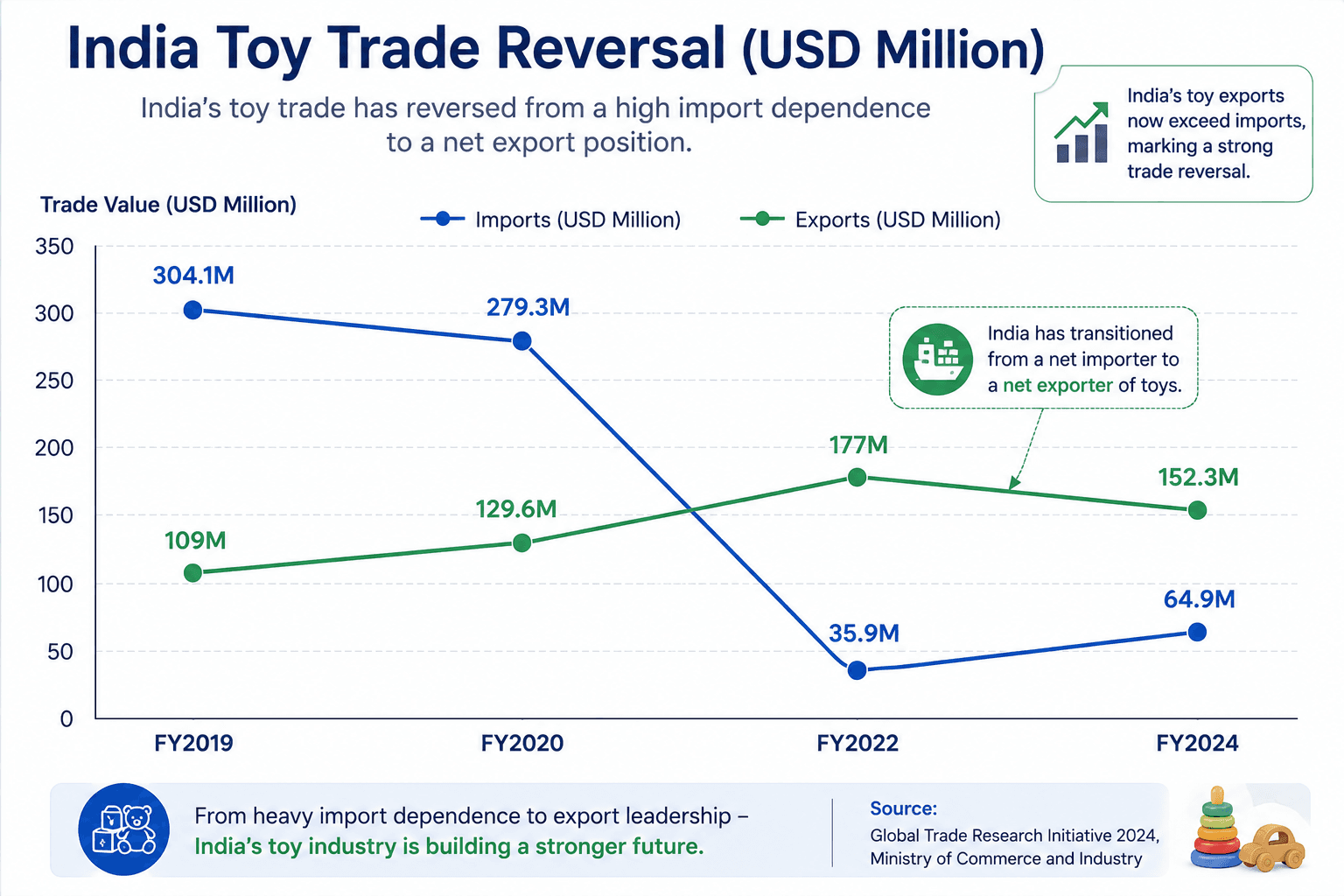
Chart Data Reference 2: India Toy Market Size Forecast (USD Billion)
- 2024: $2.13B
- 2025: $2.77B
- 2035 forecast: $5.15B to $7.82B (range across estimates) (Sources: Market Research Future 2026, Expert Market Research 2026)
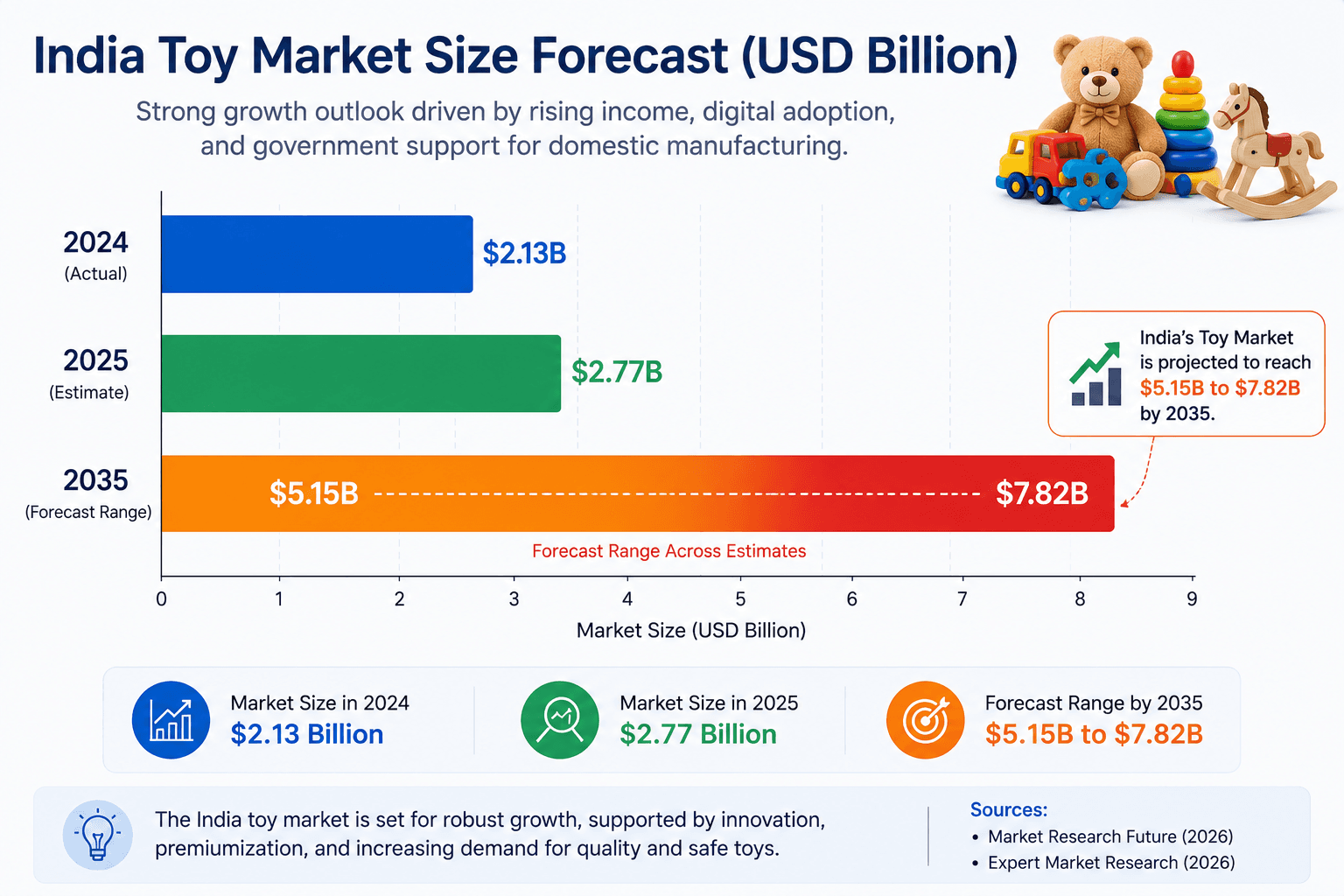
The global toy market itself provides important context. The worldwide toy market is projected to reach USD 179.4 billion by 2032 (Source: PNB Report, as cited in Tribune India, 2025). India’s domestic toy market is projected to grow from USD 2.77 billion in 2025 to USD 5.15 billion by 2035 at a CAGR of 6.40% (Source: Expert Market Research, 2026), with some estimates putting the 2035 figure as high as USD 7.82 billion at a 12.52% CAGR (Source: Market Research Future, 2026).
China’s Share Is Falling. Fast.
China’s grip on India’s toy import market has not been broken, but it has been significantly loosened, and the direction of travel is clear.
China’s share of India’s total toy imports dropped from 87% in FY2019 to 64% in FY2024 (Source: India Business Trade, 2024). In absolute terms, this represents a collapse from approximately USD 235 million in FY2019-20 to USD 39 million in FY2022-23 (Source: Organiser, 2025). An IIM Lucknow case study on India’s toy sector documented this decline as a direct consequence of the quality control and tariff measures.
The gap has been partially filled by other import sources. ASEAN countries now account for 16.7% of India’s toy imports, Sri Lanka 12.4% and the Czech Republic 4.7% (Source: India Business Trade, 2024). This diversification itself is a sign of a healthier import landscape, less dominated by a single supplier nation.
But the more important shift is on the domestic production side. The IIM Lucknow study found that India’s dependence on imported inputs for toy manufacturing fell from 33% to 12% over six years, and the number of toy manufacturing units in India doubled between 2014 and 2020 (Source: Organiser, 2025). This means Indian manufacturers are not just producing more toys, they are also sourcing more of their inputs domestically, building a genuinely deeper manufacturing capability rather than merely assembling imported components.
Whether China’s share can fall further depends on whether India can continue to build domestic capacity fast enough to meet rising consumer demand without having to reach back to Chinese supply chains.
Indian Players Finally in the Game

The policy environment has created space for a new generation of domestically oriented toy businesses to emerge, and Indian entrepreneurs have moved into that space with intent.
The organised domestic manufacturing sector has grown significantly. As of 2024, over 12,000 toy manufacturers have registered under BIS compliance (Source: Ken Research, 2026), a figure that represents both the scale of existing manufacturing and the formalisation effect of the quality control regime. Businesses that previously operated in the informal economy are now part of a regulated, certifiable manufacturing base.
The segment showing the most entrepreneurial energy is educational and STEM toys. India’s educational toys market was valued at USD 2.33 billion in 2025 and is projected to reach USD 4.71 billion by 2034 at a CAGR of 8.14% (Source: IMARC Group, 2026). STEM toys specifically are growing at a CAGR of 17.8% from 2024 to 2030 (Source: Grand View Research, 2024), the fastest growth rate of any toy segment in the country.
This growth is being powered by a generation of Indian startups that are building globally competitive products anchored in science-based learning, Indian cultural content and digital integration. Several have already found international audiences. The Ministry of Electronics and Information Technology’s e-Toycathon 2025 event specifically targeted young Indian innovators to develop homegrown, eco-friendly electronic toys, building a pipeline of future product ideas from within the country’s own talent pool.
The online channel has become a critical enabler for these newer players. Online retail now accounts for 38% of India’s total toy market in 2025, with strong growth in Tier 2 and Tier 3 cities where organised toy retail is limited (Source: IMARC Group, 2026). Quick commerce platforms are now delivering toys within 10-minute windows in urban centres, a distribution capability that gives agile domestic brands a reach that traditional toy retail never offered.
Manufacturing Clusters Getting Organised
One of the most concrete signs that India’s toy industry is maturing is the emergence of organised, government-supported manufacturing clusters that go beyond individual artisan workshops.
More than 80% of India’s toy manufacturing plants are currently based in North India, primarily in the Delhi-NCR belt (Source: Expert Market Research, 2026). This concentration has created supply chain efficiencies and a skilled labour pool, but also a geographic vulnerability that the government is actively trying to address by supporting cluster development across other regions.
In Telangana, a dedicated Toys Park is being developed in Hyderabad specifically to support local production, targeting 10,000 direct jobs and designed to accommodate rural artisans alongside modern manufacturers (Source: Expert Market Research, 2026). In Haryana, a Draft Electronic Toys Manufacturing Policy 2024 has been formulated to invite INR 1,000 crore in investment and generate another 10,000 jobs (Source: Expert Market Research, 2026).
The Ministry of MSME has supported 18 toy manufacturing clusters across the country (Source: News on Air, July 2025). In February 2020, the government approved the establishment of eight toy clusters spanning Madhya Pradesh, Rajasthan, Tamil Nadu and other states (Source: Fortune Business Insights, 2026).
Maharashtra currently leads state-level market share at 20% of the total Indian toys market in 2025 (Source: IMARC Group, 2026), supported by major manufacturing units and strong retail infrastructure. Tamil Nadu’s existing manufacturing base, anchored by its traditional wooden toy heritage and newer plastics processing capability, is also being expanded with government support.
The PLI scheme has also been extended to cover toys. In August 2023, the government directed USD 23.70 billion in PLI funds across multiple sectors, with toys included alongside leather and footwear (Source: OMR Global, 2024). The 50% reimbursement on international marketing expenses, capped at 3% of annual sales or INR 50 crore, is specifically designed to help Indian manufacturers build global export market presence.
STEM, Screens and Shifting Demand
While the policy story of India’s toy industry is about manufacturing and trade, the consumer story is equally important, and it is moving in a direction that favours domestic innovation over imported commodities.
Indian parents, particularly in urban and semi-urban areas, are rapidly shifting their toy purchasing preferences from traditional play items toward toys that combine entertainment with educational outcomes. STEM learning kits, coding robots, interactive puzzles, and AI-powered educational toys that adapt to a child’s learning pace are all seeing strong demand (Source: IMARC Group, 2026). The National Education Policy 2020, which mandated play-based learning as a pedagogical approach in early education, has provided institutional backing to this consumer shift.
India accounted for 8.6% of the global educational toys market in 2023 and is projected to be the leading market in the Asia Pacific educational toys segment by 2030 (Source: Grand View Research, 2024). STEM toys in India are growing at a CAGR of 17.8% from 2024 to 2030, the highest segment growth rate in the entire toy market (Source: Grand View Research, 2024).
The integration of Indian cultural content into modern toy formats is also emerging as a genuine differentiator. Smart toys built around Panchatantra stories, Tenali Raman tales, augmented reality experiences featuring Indian mythology, and voice recognition toys that work in regional languages are all finding market traction (Source: Expert Market Research, 2026). This is something that no Chinese manufacturer can easily replicate, and it gives Indian toy brands a moat that is cultural rather than purely competitive on price or feature.
Unisex toys now dominate with a 58% market share in 2025, reflecting changing parental attitudes toward gender-neutral play (Source: IMARC Group, 2026). Plush toys lead all product segments with a 16% market share (Source: Research and Markets, 2026). STEM toys, often priced at a premium, are driving value growth disproportionate to their volume.
Can India Become a Global Toy Hub?
India is already a net toy exporter. The question now is whether it can move from being a successful domestic market story to a genuine global manufacturing alternative.
The ambition is real. KPMG has projected that capturing just 5% of China’s plastic toy market could push India’s toy exports past the USD 500 million mark (Source: Asia Fund Managers, 2023). For context, India’s total toy exports in FY2024 were USD 152.3 million. Getting to USD 500 million would require roughly tripling exports, but the trajectory of the last five years suggests this is achievable within a decade if the enabling conditions hold.
The structural advantages are significant. India has a large, English-speaking engineering talent pool capable of designing export-quality products. Its traditional craft clusters provide a unique heritage identity that commands premium pricing in Western markets, where consumers are increasingly seeking handmade, natural, and culturally authentic alternatives to mass-produced plastic toys. Electronic toy exports grew from an average of USD 3.73 million during 2017-19 to USD 18.01 million between 2021-24, while non-electronic toy exports rose from USD 0.58 million to USD 40.18 million in the same periods (Source: Policy Circle, 2025). Both trajectories are moving sharply upward.
The challenges are equally honest. India’s share of global toy exports remains just 0.3% compared to China’s 80% (Source: Deccan Chronicle, 2024). The quality of some domestic manufacturers still needs to catch up to international retail buyers’ expectations. Rural toy artisans, for all their craft excellence, have limited access to export market channels and international buyer relationships. And the export momentum of the FY2022 peak has not yet been consistently maintained, with FY2024 exports of USD 152.3 million falling below the FY2022 high of USD 177 million (Source: GTRI, 2024).
What the last five years have conclusively proved, however, is that India’s toy industry can respond to the right conditions. When quality standards were enforced, manufacturers upgraded. When import duties created headroom, domestic producers invested. When cluster infrastructure was supported, manufacturing spread beyond its historic concentrations. The playbook is working. The question is speed.
India’s toy market is projected to reach USD 10.8 billion by 2032 across some estimates (Source: Credence Research, 2024). The global market it is competing in will be worth nearly USD 179.4 billion by the same year (Source: PNB Report, 2025). India does not need to be China to win. It needs to be unmistakably itself, which, as it turns out, is something no one else can replicate.
Sources: Global Trade Research Initiative (2024), Ministry of Commerce and Industry, India Business Trade (2024), Expert Market Research (2026), Market Research Future (2026), IMARC Group (2026), Grand View Research (2024), Ken Research (2026), PIB Government of India (2023), Policy Circle (2025), Fortune Business Insights (2026), Deccan Chronicle (2024), Organiser (2025), Next IAS (2025), Upstox (2025), Tribune India (2025), OMR Global (2024), Asia Fund Managers (2023), Credence Research (2024), News on Air (July 2025), India Filings (2026), ClearIAS (2023), Gulf News