Distribution Was the Old Moat.
Distribution is still essential in FMCG, but it is no longer enough to stay ahead. The new advantage is supply chain agility: how quickly a company sees a change in demand and adjusts its production, inventory and replenishment. This article explains why reach alone no longer guarantees growth and what FMCG leaders should ask to build a leaner, more responsive supply chain.
Anup
24 NOV 2026 · 14 min read

A company does not necessarily lose its competitive advantage because something goes wrong with its factories, warehouses or distribution network. Sometimes, everything it has built continues to work. The problem is that the market has moved on.
For decades, distribution was what separated successful FMCG companies from the rest in India. Getting products into millions of kirana stores, building dependable distributor networks and maintaining availability across different markets took years of investment and execution. It was not something a new competitor could easily replicate.
But the market does not stand still just because a business has built a strong position.
Competitors gradually learn what works. Consumers begin buying differently. New channels create opportunities that did not exist before. And suddenly, the capabilities that once made a company difficult to challenge may no longer be enough.
This is why I believe supply chain agility deserves a much bigger place in the strategic conversations happening inside FMCG boardrooms. Distribution gets products to the market. Agility determines how quickly a company can respond when the market changes.
Think about a magician performing a trick. The first time, everyone is surprised. After watching it several times, the audience starts noticing the technique behind it. The trick has not changed, but its ability to impress has.
Competitive advantages work in much the same way. Once competitors understand how something works, they eventually find ways to replicate it.
In my opinion, distribution built the scale of India's leading FMCG companies. Their ability to adapt, however, will decide whether they can maintain that leadership.
Why Distribution Alone No Longer Guarantees Growth
For much of India's FMCG industry, distribution strength was measured by reach: how many retail outlets a company could serve, how efficiently distributors could replenish them and how consistently products remained available across markets.
That foundation remains essential. India's millions of kirana stores continue to play a central role in product availability, particularly across smaller towns and rural markets. But reach is no longer the only measure of distribution effectiveness.

The same consumer may purchase through general trade, modern retail and quick commerce within a relatively short period. These channels differ not only in how orders are placed, but also in the assortment they carry, inventory movement and replenishment frequency.
As consumers move between these channels, FMCG companies have to manage a much more demanding operating environment.
The growth of quick commerce illustrates the scale of this change.
According to Bain & Company's How India Shops Online 2026, the Indian quick-commerce market reached approximately $10–11 billion in GMV in 2025, following two consecutive years of annual doubling. It represented around 16–17% of India's e-retail GMV.
What does this mean? FMCG companies are now operating across channels that demand very different approaches to serving customers.
A distribution network built around periodic replenishment to retail outlets may work well for conventional trade. But serving quick-commerce platforms can require more frequent replenishment, tighter inventory visibility and faster responses to changing demand.
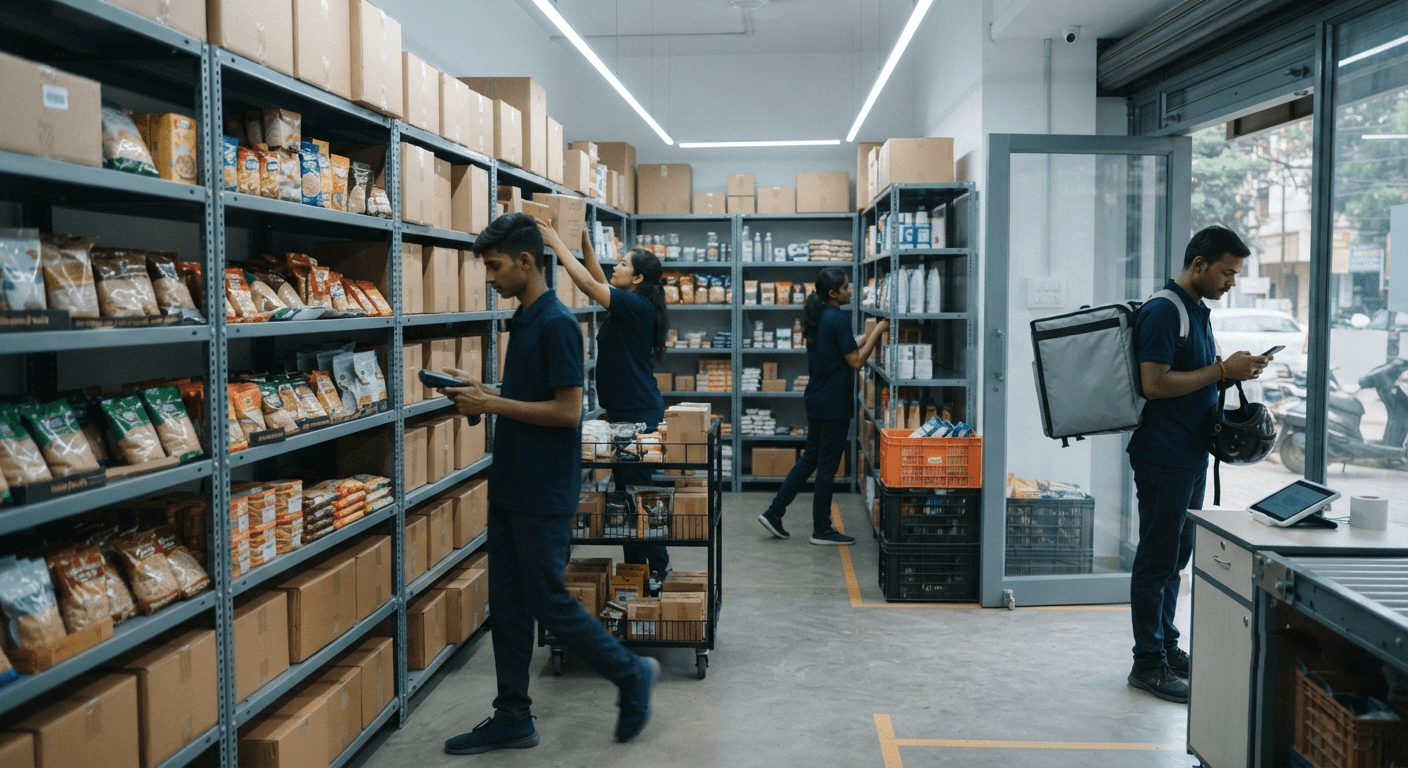
The real competitive question is no longer just how far a company's distribution network can reach. It is how quickly the business can adjust its inventory, replenishment and fulfilment decisions as market demands change.
How the FMCG distribution advantage is changing
The distribution advantage of established FMCG companies was built on several interconnected capabilities:
- Network depth: Multi-tier distributor and sub-stockist structures that extended reach beyond major markets.
- Trade relationships: Established credit arrangements that supported working capital and product movement across the distribution chain.
- Market coverage: Beat-level sales operations that maintained retailer engagement and provided regular market visibility.
- Availability: The ability to maintain product presence across geographically dispersed markets.
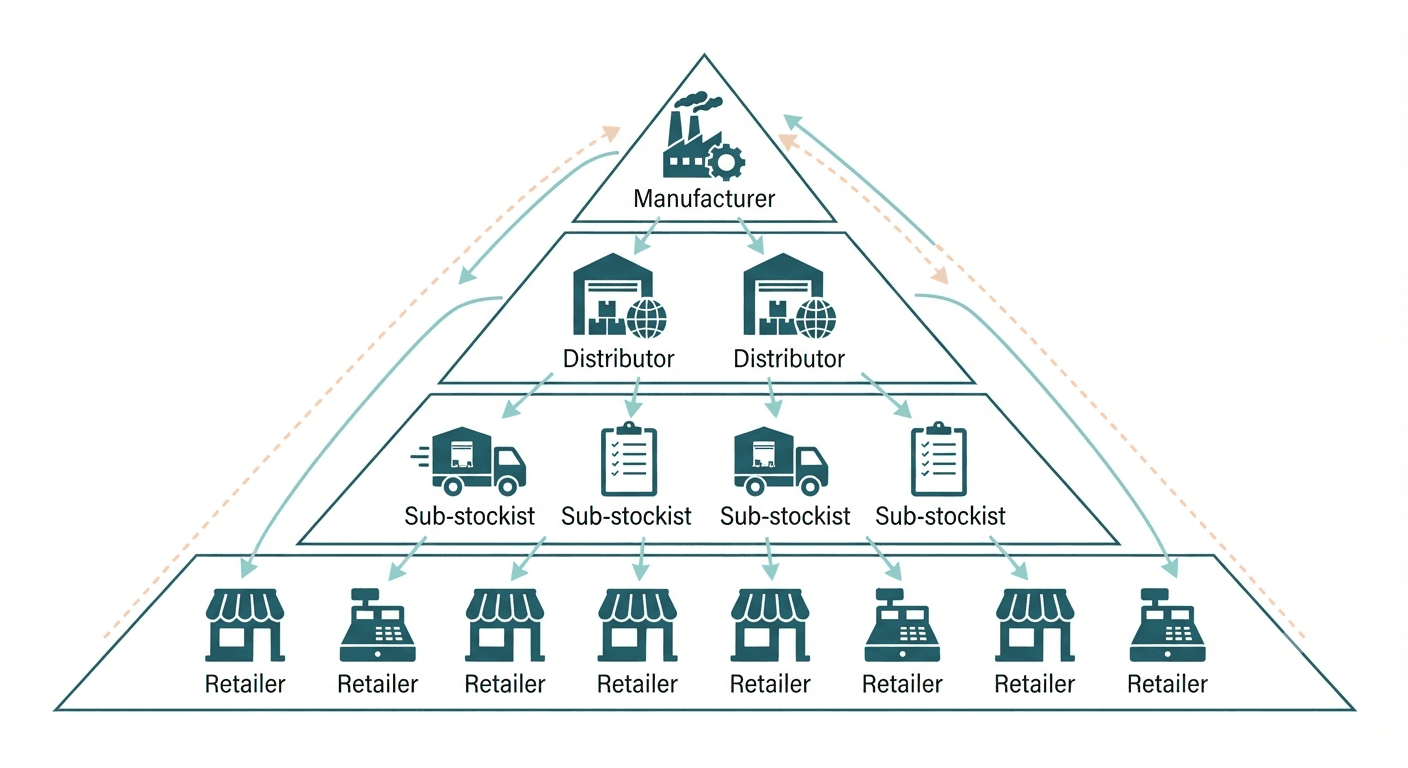
Individually, each capability strengthened a different part of the distribution network. Together, they created a network that competitors could not easily replicate. Building it required years of investment, strong trade relationships, local market knowledge and consistent execution.
Indirect trade is no secret. Every FMCG company knows how it works. Companies paid distributors to take care of reaching retailers, giving them more control over market execution and allowing the companies to focus on other parts of the business. This also gave distributors greater depth in their respective markets. The logic was simple: if I have a distributor in Pune, I can sell my product in Pune.
It worked, and it still does. But the model itself is no longer exclusive knowledge. Building the relationships, credit arrangements and local execution still takes years.
A well-established network can help products reach millions of retailers. But what happens when demand shifts unexpectedly, a new channel starts gaining traction or consumers begin buying differently?
Reach gets products into the market. The ability to respond determines how effectively a company can keep up with it.
When Past Success Becomes Organisational Inertia
As mentioned above, one of the biggest challenges for an established FMCG company may not be a lack of market understanding, but its ability to respond to changes in a market it already knows well.
Large businesses develop processes and reporting structures to manage complexity. Decisions pass through functions, approval layers and established operating procedures. These systems are essential for maintaining control across large operations.
The difficulty begins when these processes make it harder to respond to something that requires immediate attention.
Imagine a product suddenly gaining traction in a particular region. The sales team notices the increase, but demand planning may not receive the information immediately. Production is already working to an existing schedule. Procurement has committed to certain quantities. Meanwhile, the inventory needed to serve that demand may be sitting in another location.
By the time these functions align and agree on a course of action, the opportunity to meet that demand may already have passed.
The delay is not always caused by poor planning or insufficient technology. It can emerge from the way decisions are distributed across the business.
This matters particularly in FMCG, where demand can vary significantly by region, season, price point, pack size and channel. Even companies with extensive market coverage can struggle to translate local demand signals into timely operational decisions.
In my view, the question is not simply how much market data the organisation collects, but how quickly that information changes the decisions being made across the business.
Three questions can help expose this gap:
- How quickly are sales and distribution signals reflected in demand plans?
- How much decision-making authority sits with the teams closest to the market?
- What delays occur between identifying a problem and implementing a corrective action?
Operational agility is therefore not just a matter of speed. It depends on how effectively an organisation connects information, decision-making authority and execution across functions.
Staying Ahead of Demand Is the Real Competitive Advantage
Demand is not something an FMCG company can forecast once at the beginning of a quarter and expect to follow the same pattern throughout.
It changes constantly. A particular pack size may sell faster in one region, while consumers in another market show a preference for premium products. Promotions can create sudden spikes in demand, but those increases do not always translate into sustained sales.
Recent data from NIQ's FMCG Quarterly Snapshot for April–June 2026 reported that India's FMCG value growth stood at 0.8% year-on-year, while volumes declined by 2%. Rural volumes fell by 5%, compared with an almost flat 0.1% in urban markets. Around 68% of FMCG categories recorded volume declines.
A national average like this is useful, but it hides a lot. Consumer purchases, distributor sales and channel-level demand can tell different stories about what is happening across the business.
For leaders, relying on a single national forecast can hide these differences. The more useful question is where demand is changing, which products and markets are driving that change, and whether the organisation can adjust its plans accordingly.
Demand visibility must lead to operational action
Knowing where demand is changing does not automatically mean a business can respond to it. The real challenge is translating market signals into timely decisions across production, procurement, inventory and fulfilment.
Consider a product that suddenly starts selling faster in one region. The organisation needs to determine:
- Whether enough inventory is available near that market.
- Whether production or replenishment schedules can be revised.
- Whether distributor commitments and channel requirements allow stock to be redirected.
- How to meet the additional demand without leaving other markets with excess inventory.
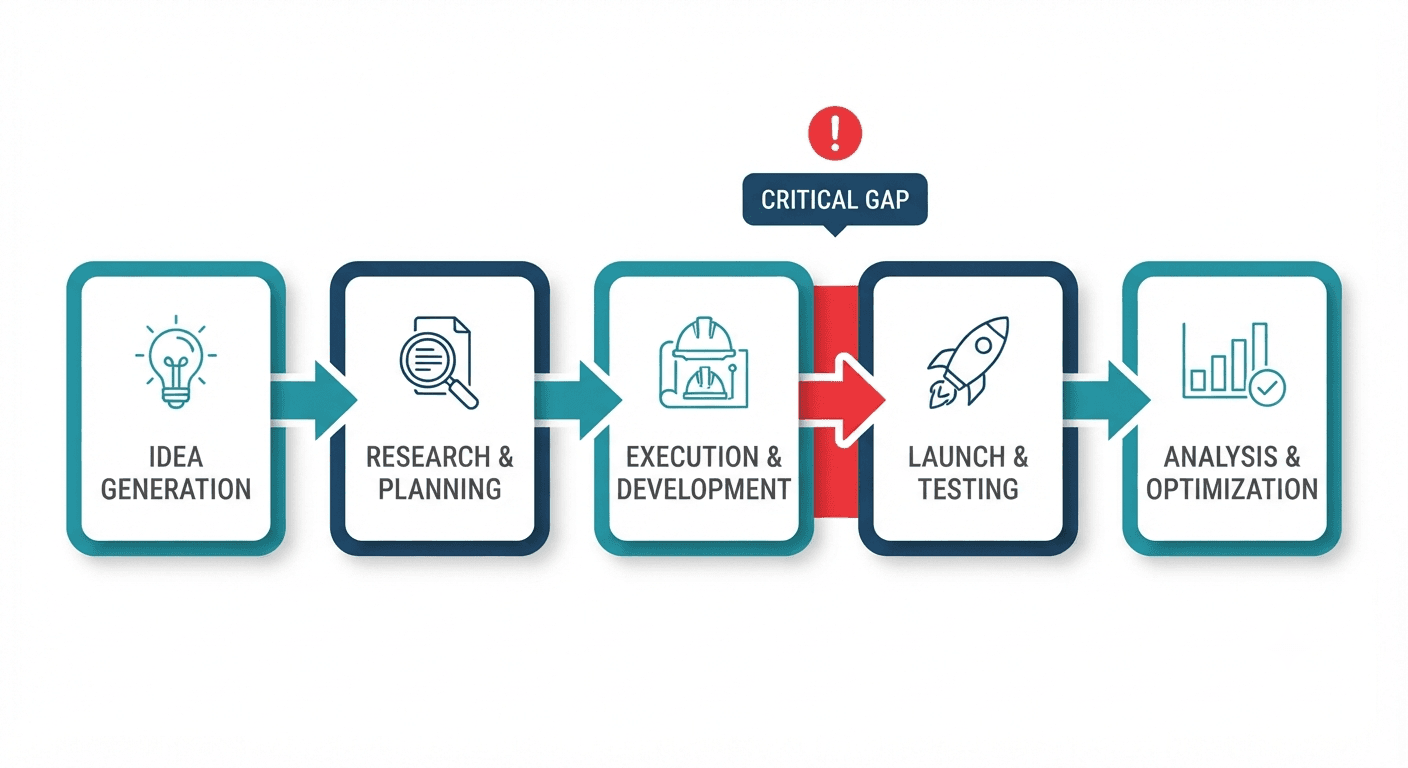
No organisation can predict every shift in consumer demand with complete accuracy. Nor should that be the expectation.
What matters is how quickly the business can recognise a change, assess its impact and align the relevant functions to respond before the opportunity is lost or operational costs increase.
Why a Leaner Supply Chain Wins
A leaner supply chain is not about running with less of everything. Having fewer warehouses or keeping inventory levels low does not automatically make a business more agile.
What matters is how easily the organisation can adjust when the market asks it to do something different.
Consider a company supplying both traditional retailers and quick-commerce platforms.
The way it serves a traditional retailer is often built around distributor orders, beat schedules, larger case quantities and credit arrangements. Quick commerce works differently. It may require smaller fulfilment quantities, different product assortments and more frequent replenishment to individual dark stores.
The product may be the same, but the operating requirements are not.
This is where seemingly small operational decisions can become significant.
- Case packs and picking requirements: Packaging designed for conventional retail distribution may not suit the smaller quantities or piece-level picking requirements of a dark store.
- Minimum order quantities: A business may want to adjust its purchasing plans, but existing procurement commitments can make that difficult.
- Fill rates and service expectations: Missing a replenishment window can directly affect product availability in channels where customers expect rapid fulfilment.
- Working capital: A business may hold sufficient inventory overall but still experience stockouts because the available stock is not positioned where demand exists.
These constraints cannot be addressed independently. They involve connected decisions across sales, procurement, production, inventory management and fulfilment.
In my view, most of the companies that responded faster to a change in demand did so because their supply chain or operating model was leaner. It was not about size. It was about how few steps stood between seeing the change and acting on it.
That is why a leaner supply chain should be judged by how well it responds, not simply by how much it has reduced.
Reducing inventory without improving allocation can increase stockout risks. Increasing production capacity without understanding where demand exists can create a different set of problems.
What matters is how effectively a business coordinates its supply chain decisions to meet changing demand while maintaining control over cost, service levels and working capital.
Different Channels Require Different Operating Models
One reason FMCG companies struggle to adapt is that they often try to manage every sales channel using the same operating assumptions.
Traditional trade, modern trade and quick commerce may all sell the same products, but the way those products need to be planned, replenished and delivered can be very different.
The following comparison illustrates these differences. These are typical operating patterns rather than fixed rules for every category or retailer.
Operating consideration | Traditional trade | Modern trade | Quick commerce |
|---|---|---|---|
Replenishment pattern | Often linked to distributor and retailer cycles | Planned store or warehouse replenishment | More frequent replenishment to dark stores |
Typical order unit | Distributor or retailer case quantities | Store-level or centralised orders, depending on the retailer | Often smaller, platform-specific fulfilment quantities |
Demand signals | Sales coverage, retailer orders and distributor movement | Store sales, centralised data and promotions | Frequent platform-level sales and availability signals |
Key operating pressure | Reach, credit and retailer availability | Assortment, shelf availability and promotion execution | Availability, replenishment speed and fulfilment service levels |
This is why a company cannot simply take its traditional distribution model and expect it to work across every channel.
Treating them as identical can create inefficiencies. Treating them as entirely separate can fragment planning and increase operating complexity.
The objective is not to build three separate supply chains. It is to create a coordinated operating model with enough flexibility to serve different channel requirements without introducing unnecessary complexity.
Why Operational Excellence Is Difficult to Replicate
A competitor can observe how a company distributes its products, understand its commercial practices and eventually build a similar network.
Replicating an organisation that consistently makes coordinated decisions is far more difficult.
Operational excellence does not come from a single successful initiative. It develops through the way an organisation shares information, establishes priorities, assigns accountability and responds when business conditions change.
Think about what happens when the sales team identifies an opportunity in a particular market. That information is useful only if procurement can act on the sourcing requirements, production can adjust its plans, finance understands the working-capital implications and supply chain teams can get the right products to the right locations.

Each function plays a role, but the outcome depends on how effectively these decisions are connected.
When departments optimise only for their individual targets, the organisation can become less responsive even when each function appears to be performing efficiently.
In my view, operational agility therefore needs to be understood as a leadership responsibility. It requires clear decision ownership, shared priorities and accountability that extends beyond individual departments.
Technology has an important role to play, but introducing a new system does not automatically solve disconnected ways of working. If responsibilities remain unclear and processes remain fragmented, the same problems can continue in a different form.
The most valuable investments are those that improve visibility across functions, reduce unnecessary handovers and help teams act before delays begin affecting business performance.
Four Questions Every FMCG Leader Should Ask
Operational agility is difficult to improve without first understanding where the organisation loses its ability to respond.
Leaders should examine four areas of their operating model:
- How long does it take to turn a demand signal into action? Evaluate the gap between identifying a change in demand and adjusting production, procurement, inventory or replenishment plans.
- Is our inventory positioned where demand exists? Look beyond overall inventory levels to understand whether products are available in the right locations, quantities and product mix.
- Does our operating model reflect the requirements of each channel? Assess whether replenishment cycles, assortment decisions and service levels are aligned with how traditional trade, modern trade and quick commerce operate.
- Are decisions connected across functions? Examine whether sales, procurement, production, finance and supply chain teams work with shared priorities and a consistent understanding of business requirements.
These questions are not about making every process faster at any cost. They help leaders identify where disconnected decisions create unnecessary costs, delays and missed market opportunities.
The Next Market Leader Might Not Be the Biggest
India's FMCG market will continue to reward strong brands, extensive distribution reach and a deep understanding of consumers. These remain important sources of business strength.
But I believe they are no longer enough on their own.
Can the organisation recognise a change in demand before it becomes a service problem? Can it reposition inventory without creating excess stock elsewhere? Can sales, procurement, production and supply chain teams translate the same market signal into coordinated action?
These questions point to a broader shift in competitive advantage. The next phase of FMCG growth will depend not just on understanding the market, but on how effectively organisations respond to what they learn.
Distribution helped build the leaders of yesterday. The ability to adapt may determine the leaders of tomorrow.
For established FMCG companies, preparing for that shift may be just as important as protecting the strengths that built their businesses.
Frequently Asked Questions
What is supply chain agility in the FMCG industry?
Supply chain agility is an FMCG company's ability to respond effectively to changes in consumer demand, sales channels, product mix and supply conditions. It requires coordination across demand planning, procurement, production, inventory management and fulfilment so that market changes can translate into timely operational decisions.
Why is distribution no longer enough to create a competitive advantage?
Distribution remains essential, particularly in a diverse market like India. However, established distribution practices can be studied and replicated over time. FMCG companies increasingly need operational flexibility alongside distribution reach to respond to changing demand, manage different sales channels and maintain product availability.
How does a lean supply chain improve FMCG performance?
A lean supply chain reduces unnecessary delays, excess inventory and inefficient processes without compromising the ability to respond to demand. It helps businesses position inventory closer to actual demand, adjust operational priorities and meet different channel requirements while managing service levels and working capital.
How does quick commerce affect FMCG supply chains?
Quick commerce introduces different operating requirements around product assortment, replenishment frequency, dark-store availability and fulfilment speed. FMCG companies may need to adapt pack formats, inventory positioning and planning processes to serve these platforms effectively.
What should FMCG leaders measure to improve supply chain agility?
Leaders can track demand-response time, forecast accuracy, stockout rates, fill rates, inventory days, working-capital utilisation and the time required to adjust production or replenishment plans. These metrics should be evaluated together because improving one measure in isolation can sometimes create trade-offs elsewhere in the supply chain.