The Accounting Cycle: A Complete Guide to How Every Rupee Gets Recorded
3 JUN 2026 · Updated 2 NOV · 15 min read

A survey by Sage found that businesses with poor accounting hygiene are three times more likely to face cash flow crises and twice as likely to fail an external audit. In India, where the Companies Act 2013 mandates proper books of accounts, GST filings demand transaction-level accuracy every month, and Income Tax scrutiny has intensified, the quality of a business’s accounting process is not just an internal matter. It is a regulatory obligation with real financial consequences.
Most finance professionals are familiar with the accounting cycle, but familiarity and rigour are different things. Many businesses follow the steps in name but shortcut them in practice: journal entries batched and posted infrequently, adjusting entries skipped under deadline pressure, trial balances accepted with unexplained differences. The result is financial statements that are technically produced but not genuinely reliable.
The accounting cycle is a structured, repeatable process that transforms raw financial events into verified, auditable financial statements. Understanding each step properly and building the discipline to follow it rigorously is what separates businesses that always know where they stand from those that are perpetually catching up.
What Is the Accounting Cycle?

The accounting cycle is the complete sequence of steps that a business follows to record, process, and report its financial transactions for a given accounting period. It begins the moment a financial transaction occurs and ends when the books are formally closed for that period and the financial statements are produced.
The cycle repeats at the end of every accounting period, whether monthly, quarterly, or annually. Each iteration builds on the last, with the closing balances of one period becoming the opening balances of the next, making the accounting cycle the backbone of a business’s financial history.
The purpose of the accounting cycle is threefold: completeness (every transaction is captured), accuracy (every transaction is recorded correctly, in the right account, for the right amount, in the right period), and verifiability (every number can be traced back to an original transaction). A business that completes the cycle rigorously can defend every line of its financial statements to an auditor, a tax authority, or an investor.
In the Indian context, the accounting cycle is shaped by several specific requirements. The financial year runs from April 1 to March 31, creating an annual cycle deadline that is harder and more consequential than in many other jurisdictions. Within that year, GST return filings create monthly or quarterly sub-cycles that demand transaction-level accuracy on a regular basis. TDS deductions must be recorded and reconciled monthly. Advance tax payments in June, September, December, and March create cash flow entries that must be correctly accounted for. The accounting cycle, done properly, accommodates all of these requirements as a matter of course.
The Accounting Cycle vs. The Budget Cycle: What Is the Difference?
These two cycles operate in parallel but serve fundamentally different purposes, and confusing them leads to gaps in how businesses manage their finances.
The accounting cycle is a historical process. It records what actually happened: the transactions that took place, the revenue that was earned, the expenses that were incurred, and the assets and liabilities that changed hands. It is backward-looking by design, and its output is a verified record of the past.
The budget cycle is a forward-looking process. It projects what is expected to happen: the revenue the business plans to generate, the costs it expects to incur, and the financial position it aims to reach. Its output is a plan for the future.
The two intersect during performance management: when actual results produced by the accounting cycle are compared against the budget plan to identify variances and inform decisions. But they are built differently, serve different purposes, and should never be conflated. Businesses that try to run both processes through the same set of spreadsheets typically end up with neither process working well.
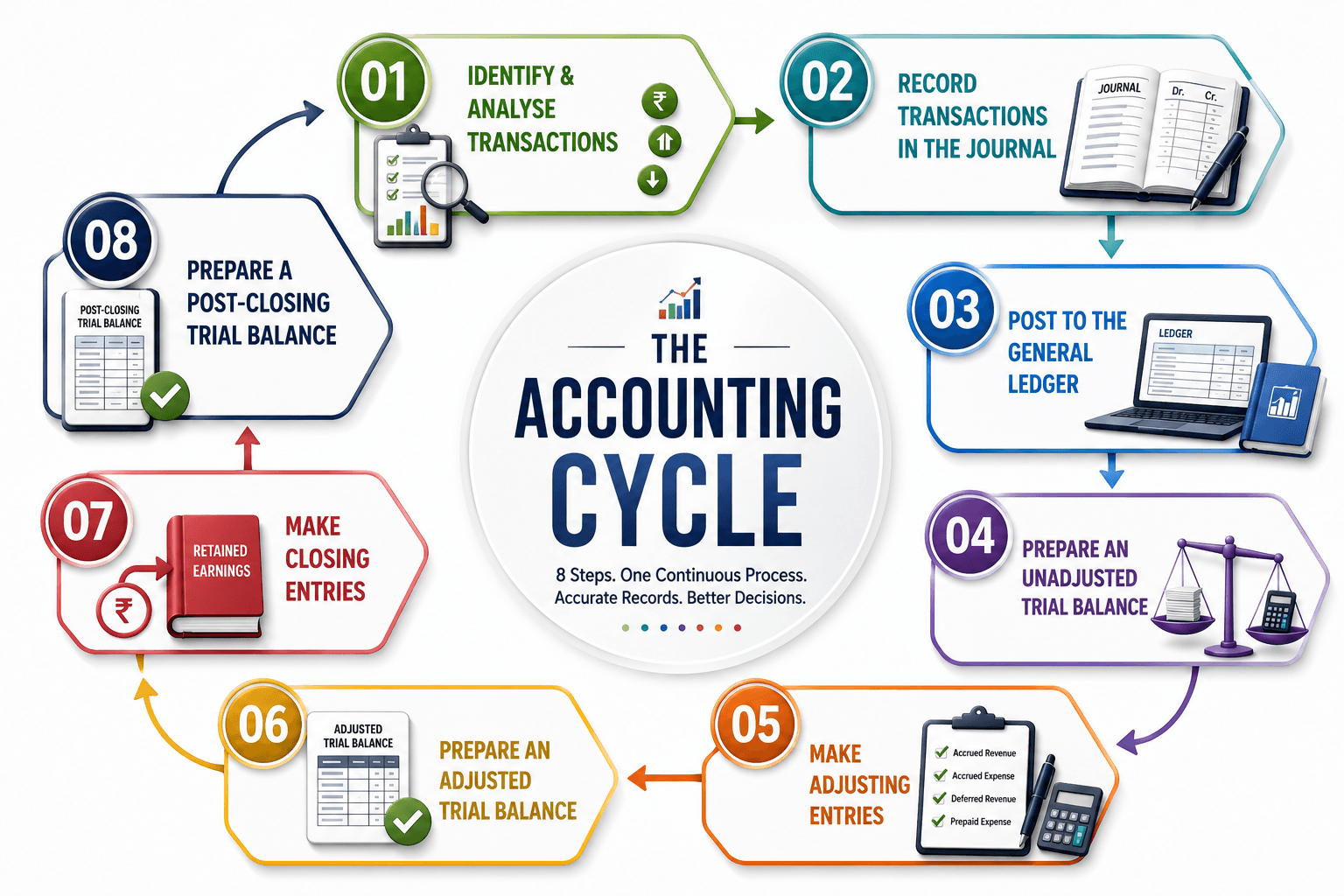
The 8 Steps of the Accounting Cycle
- 1
Identify and Analyse Transactions
Every accounting cycle begins with identifying financial transactions: a sale made, invoice received, salary paid, loan taken, asset purchased, or tax liability accrued. Not every business event is a financial transaction; a sales call or hiring interview has no immediate monetary impact and does not enter the cycle.
The analysis step requires determining which accounts are affected, whether each is an asset, liability, equity, revenue, or expense, and whether the amount increases or decreases each account. In India, this must also consider GST implications: is it a taxable, exempt, or zero-rated supply, and what are the input tax credit consequences? Getting classification right here prevents a cascade of errors through every subsequent step.
- 2
Record Transactions in the Journal
Once a transaction is identified and analysed, it is recorded in the journal, the chronological record of every financial event. This is governed by the double-entry principle: every transaction affects at least two accounts, with debits always equalling credits. A journal entry captures the date, accounts affected, amounts, and a narration describing the transaction. Most Indian businesses use Tally, Zoho Books, or SAP, where the system enforces debit-credit balance automatically. The quality of the narration is often underestimated: a well-written narration makes the audit trail significantly easier to follow months or years later.
- 3
Post to the
After journal recording, transactions are posted to the general ledger, the master record of every account showing its running balance across all transactions. In modern accounting software, posting happens automatically when a journal entry is saved, eliminating transcription errors. However, the entry still needs to be correctly coded; account miscoding remains one of the most common sources of ledger errors.
- 4
Prepare an Unadjusted Trial Balance
At the end of the period, before any adjustments, the finance team prepares an unadjusted trial balance: a listing of every ledger account with its closing balance to verify that total debits equal total credits. A trial balance that does not balance indicates a recording or posting error that must be corrected before proceeding. Importantly, a balanced trial balance does not mean accounts are correct only arithmetically consistent. A transaction posted to the wrong account leaves the balance intact while producing incorrect account balances.
- 5
Make Adjusting Entries
Adjusting entries are one of the most important and most frequently skipped steps in the accounting cycle. They are journal entries made at the end of the period to ensure that revenues are recognised in the period they were earned and expenses in the period they were incurred, regardless of when cash actually changed hands. This is the accrual basis of accounting, and it is the standard required by the Companies Act for all Indian companies above a prescribed threshold.
There are four primary categories of adjusting entries. Accrued revenues are revenues earned but not yet billed or received for example, services delivered in March that will be invoiced in April. Accrued expenses are costs incurred but not yet paid or recorded for example, employee salaries for the last week of March that will be paid in April. Deferred revenues are cash received in advance of the service being delivered for example, an annual subscription fee collected upfront. Prepaid expenses are costs paid in advance that cover a future period for example, an insurance premium paid in January that covers six months.
In India, adjusting entries also include provisions for income tax and deferred tax, depreciation entries for fixed assets under the Companies Act schedule, GST-related adjustments for input tax credit reversals, and TDS payable accruals. Skipping or under-preparing adjusting entries is the single most common cause of misstated financial statements in small and mid-sized Indian businesses.
- 6
Prepare an Adjusted Trial Balance
Once all adjusting entries are posted, the finance team prepares an adjusted trial balance: the same account listing, now reflecting all adjustments, confirming that debits still equal credits. This is the direct source for the financial statements that follow. Every income statement line, every balance sheet figure, every cash flow item is drawn from here. Errors not caught at this stage flow directly into the financial statements and into every report, filing, and decision built on them.
- 7
Make Closing Entries
Closing entries reset temporary accounts, which are revenue and expense accounts, to zero at the end of the period and transfer their net balance to retained earnings in equity. Revenue and expense accounts are temporary because they measure performance over a specific period; zeroing them out ensures the next period starts clean. The net difference between revenues and expenses, the period’s profit or loss, permanently updates the equity section of the balance sheet. Asset, liability, and equity accounts are permanent and carry their balances forward unchanged.
In Indian businesses on the April-to-March financial year, closing entries must also account for profit transfers to reserves, proposed dividends, and statutory transfers required under the Companies Act.
- 8
Prepare a Post-Closing Trial Balance
The final step in the accounting cycle is the preparation of a post-closing trial balance. This lists only the permanent accounts assets, liabilities, and equity after all closing entries have been made. Its purpose is to confirm that the ledger is in balance after closing, and that only permanent account balances remain open to carry forward into the next period.
A clean post-closing trial balance signals that the accounting cycle for the period has been completed correctly and that the books are ready for the next period to begin. The closing balances of each permanent account become the opening balances of those same accounts in the next period, carrying the financial history of the business forward seamlessly.
Why the Accounting Cycle Matters for Your Business

It Is the Foundation of Every Financial Decision
Every significant financial decision a business makes whether to hire, invest, expand, or conserve cash should be grounded in accurate financial data. The accounting cycle is the process that produces that data. A business that follows the cycle rigorously has financial statements it can trust. A business that shortcuts the cycle has numbers that may look correct on the surface but carry hidden errors that distort every analysis built on top of them.
It Makes Regulatory Compliance Manageable
Indian businesses face an unusually dense compliance calendar: monthly GSTR-1 and GSTR-3B filings, quarterly TDS returns, annual income tax filings, ROC annual returns, and statutory audit requirements. Every one of these obligations draws on the data produced by the accounting cycle. When the cycle is followed properly and consistently, compliance becomes a reporting exercise rather than a reconstruction exercise. When it is not, every filing deadline becomes a scramble to reconcile months of under-maintained records under time pressure.
It Creates a Verifiable Audit Trail
Every step of the accounting cycle, from the original journal entry to the final post-closing trial balance, creates a documented record. This audit trail is what allows an external auditor, a tax officer, or an internal reviewer to trace any number in the financial statements back to the original transaction that generated it. Businesses that maintain a clean accounting cycle consistently pass audits faster, with fewer queries, and with lower professional fees, because the work of substantiating the numbers has already been done as part of the routine process.
It Enables Early Detection of Errors and Fraud
The trial balance steps, the adjusting entry process, and the reconciliation that underlies the cycle are all opportunities to catch errors and irregularities before they compound. A journal entry posted to the wrong account, a payment that does not match any invoice, an accrual that was never reversed these are the kinds of issues that surface during a disciplined accounting cycle and can be corrected quickly. In a poorly maintained accounting environment, the same issues accumulate silently for months and can represent significant financial damage by the time they are discovered.
Common Mistakes Businesses Make in the Accounting Cycle

Infrequent and Batched Journal Entries
Many small and mid-sized Indian businesses, particularly those running on Tally, record journal entries in batches: weekly, fortnightly, or even monthly. The problem with infrequent entry is that the details and context around transactions fade with time. An expense incurred three weeks ago may be difficult to classify correctly when it is finally entered. The narrations become vague, the account coding becomes approximate, and the resulting ledger is less accurate than it would have been if entries had been made daily.
Skipping Adjusting Entries
Adjusting entries are time-consuming and require accounting judgement, which makes them the step most frequently shortcut under deadline pressure. Businesses that skip adjusting entries produce cash-basis financial statements while believing they are producing accrual-basis ones. The result is revenue recognition that does not match the period of performance, expense recognition that does not match the period of benefit, and financial statements that are neither accurate nor compliant with the Companies Act.
Accepting Unexplained Trial Balance Differences
A trial balance that does not balance to zero must be investigated and corrected. Yet many businesses accept small differences as rounding errors or force them into a suspense account to meet a close deadline. Unexplained trial balance differences are not rounding errors; they are recording errors that, if not corrected, will misstate the financial statements. Every difference, no matter how small, deserves an explanation.
Wrong Period Posting
Posting a transaction to the wrong accounting period, for example entering a March expense in April, seems minor but has real consequences. It misstates the profitability of both periods, affects GST filings for the relevant months, and creates reconciliation problems that can take significant effort to unwind. Enforcing period-lock discipline in accounting software, so that closed periods cannot be posted to without an authorised override, is one of the simplest and most effective controls a business can implement.
No Formal Close Process
Many businesses treat the accounting cycle as a continuous process rather than a periodic one with a defined end point. Without a formal close checklist, specific individuals cannot be held accountable for completing each step, and the cycle never reaches a state of completion. The books remain perpetually open and perpetually in flux, making it impossible to produce reliable period-end financial statements or to compare one period’s results meaningfully against another’s.
Best Practices for a Clean Accounting Cycle
Define and Enforce a Close Calendar
Every accounting period should have a defined close date, a checklist of steps that must be completed before close, and a named owner for each step. The close calendar should be published at the beginning of the financial year and treated as a non-negotiable deadline. In Indian businesses where the GST return filing deadline creates a natural forcing function for the monthly close, the accounting cycle close should be scheduled to precede the GST filing date rather than follow it.
Maintain a Clean and Consistent Chart of Accounts
The chart of accounts is the architecture of the general ledger, and its quality determines the quality of everything built on it. A chart of accounts with too many accounts creates unnecessary complexity and inconsistent coding. One with too few creates accounts that mix dissimilar transactions and produce financial statements that lack the granularity needed for management reporting. Review and rationalise the chart of accounts at least annually, and enforce coding consistency through account-level guidance documents that every person entering transactions can reference.
Reconcile Every Balance Sheet Account Every Period
The adjusted trial balance confirms that the ledger is arithmetically in balance, but it does not confirm that individual account balances are correct. The only way to confirm account correctness is to reconcile each balance sheet account against an external source or sub-ledger every period. Bank accounts against bank statements. AR against the customer sub-ledger. AP against vendor statements. Fixed assets against the fixed asset register. This reconciliation is the quality control layer that catches errors the trial balance cannot.
Enforce Period Locks in Your Accounting System
Once a period has been closed, it should be locked in your accounting software so that no further postings can be made to it without an authorised override. Period locking prevents accidental or unauthorised postings to closed periods, ensures that comparative period data remains stable, and removes the temptation to adjust prior period entries to fix current period problems. Most accounting software, including Tally and Zoho Books, supports period locking natively.
Document Adjusting Entries With Supporting Calculations
Every adjusting entry should be accompanied by a supporting calculation or schedule that explains how the amount was determined. The accrued expense entry should reference the underlying contract or invoice. The depreciation entry should tie to the fixed asset register. The deferred revenue entry should show the calculation of the portion recognised versus deferred. Documentation of adjusting entries is not just good practice; it is what makes the entries defensible during a statutory audit or tax assessment.
Use Automation to Eliminate Manual Bottlenecks
The steps of the accounting cycle that consume the most time transaction data entry, posting, trial balance preparation, and reconciliation are also the steps most amenable to automation. Modern accounting platforms can capture transaction data directly from bank feeds, payment gateways, and procurement systems, eliminating manual data entry entirely. They can post to the general ledger in real time, prepare trial balances automatically, and flag accounts that are out of balance without anyone having to check manually. Platforms like Finifi take this further by integrating the accounting cycle with reconciliation, compliance, and reporting workflows, so that the close process becomes a structured, trackable, and largely automated exercise rather than a manual scramble at the end of every month. For Indian businesses managing the simultaneous demands of GST filings, TDS compliance, and financial close, automation is not a convenience. It is the only way to maintain the rigour that the accounting cycle demands without overwhelming the finance team.
The accounting cycle is not a formality. It is the discipline that turns a business's financial activity into financial truth. The businesses that follow it rigorously always know where they stand. The ones that do not are always finding out too late.